
Solo Female Travel in Kyoto: The Short Answer
Yes, Kyoto is very safe for a woman travelling alone, and it is one of the safest cities in Asia, with very low violent crime and streets that stay busy and lit well into the evening. Japan sits at Level 1, exercise normal precautions, on the US State Department advisory, and no advisory singles Kyoto out. The real difficulties in Kyoto are crowds, not crime: packed temple approaches in the fall foliage season, crowded buses, and stations run by several rail companies. Stay in central Kyoto, go early to the big sights, keep the bag in front in a crowd, and Kyoto is an easy first city in Japan. The country level detail is our Japan safety guide.
Why Kyoto Feels Safe for Solo Women
Kyoto feels safe because it is orderly, watched and walked. The streets are clean, the stations are staffed around the clock, and the city runs on a pattern a first timer can learn in a day. Japan ranks 10th of 163 countries on the 2026 Global Peace Index, with a score of 1.489, and the homicide rate is 0.23 per 100,000 people, from 2023 World Bank and UNODC figures. A woman alone in Kyoto is one of many people on the same street, and the city is full of solo diners, solo walkers and solo travellers, so eating alone or walking alone draws no attention at all. The city rewards a slow pace: pick one cluster a day, walk it slowly, and come back to the same central streets each evening, because the temples are quietest early in the morning and the lanes are at their best in the lantern light of the evening.
Fushimi Inari: Go Early, Climb Past the Crowds
Fushimi Inari Taisha is the sight to see first, and the sight to see early. The shrine is famous for its thousands of vermilion torii gates, and the lower paths fill with visitors by mid morning, especially in November, when the fall foliage season puts the temple areas at their most crowded. Go first thing in the morning, before the crowds arrive, and climb past the lower gates toward the top, where the paths go quiet and the city opens out below. The climb is the reward, because the gates thin out, the noise falls away, and the shrine becomes a walk rather than a queue. Bag snatching and pickpocket risk in Kyoto is only a factor in extremely crowded spots like Fushimi Inari at peak hours, so keep the bag zipped and in front on the lower paths. The shrine is open at all hours, the walk up takes about two hours at a slow pace, and a first timer who goes early and climbs high has the best of Fushimi Inari, with the rest of the day free for the quieter sights.
The Higashiyama Cluster: One Walk, Five Sights
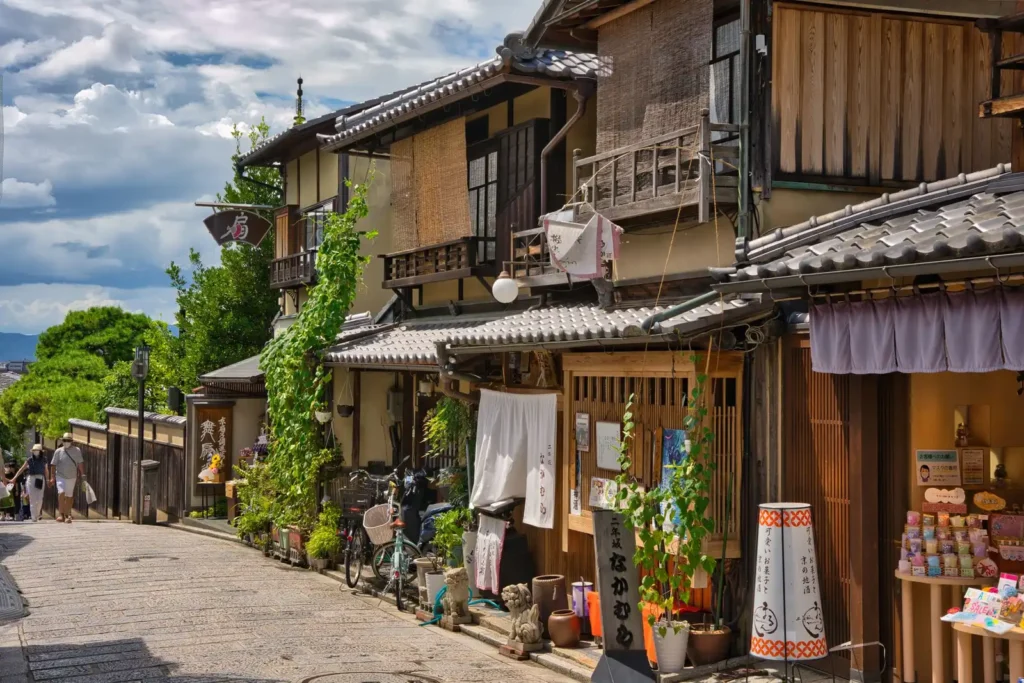
The Higashiyama cluster is the walk to plan a whole morning around, because five sights sit within walking distance of each other. Start at Kiyomizu-dera, the wooden temple on the hillside, then walk down through Ninenzaka and Sannenzaka, the preserved wooden streets that run busy from 8 AM to 10 PM, with shops, tea houses and cafes in old wooden buildings. From there, Yasaka Shrine sits at the end of the lanes, and Kodai-ji, the quiet temple with its gardens, is a short walk away. The whole cluster is walkable, and the streets between the sights are the sight, with the wooden facades, the lanterns and the smell of tea. The cluster is also where the crowds are thickest, so the same rule applies as at Fushimi Inari: go early, keep the bag in front, and let the midday crowds pass while sitting in a tea house. Walk the cluster in the morning, rest in the afternoon, and come back in the evening, when the lanterns are lit and the lanes are at their best.
Gion: Lantern Streets and Geiko Etiquette
Gion is the old Kyoto of the postcards, with Hanamikoji Street pedestrianised in the evenings, lanterns lit along the wooden facades, and the machiya town houses that make the district feel like another century. The streets are at their best in the early morning and the evening, when the day crowds have gone and the lanterns come on. Walk Hanamikoji slowly, look at the wooden lattices and the tea houses, and enjoy the quiet of a district that has kept its shape for generations. The geiko district has one rule a visitor must respect, and it is about privacy, not danger. Do not photograph geiko on the private lanes. Etiquette signs restrict photography in the narrow lanes where geiko live and work, and fines apply, because the women are going to work, not posing for visitors. A geiko seen on a main street can be watched and admired, and a photo from a respectful distance on a public street is a different matter from following one down a private lane with a camera. Put the camera away on the private lanes,
and Gion rewards the visitor who walks slowly and looks carefully.
Arashiyama and Northern Higashiyama: The Slow Stops
Arashiyama sits out west, across the river, and it is the scenic and calmer stop, with the Bamboo Grove, the river, and temples that feel a world away from the centre. The grove is beautiful in the early morning, before the day trippers arrive, and the river walk is the place for a slow afternoon. Arashiyama is a day trip from a central base, not a first base, because it is out west and the buses back run early, so a stay there means planning every evening around the bus timetable. Single sex onsen bathing exists in Arashiyama, and it is a good slow stop for a second day, when the centre has been walked and the pace can drop. Northern Higashiyama is the other slow stop, with quieter temples and the Philosopher’s Path, the stone walk along the canal that is at its best in the morning, when the path is empty and the temples are just opening. Both stops share the same lesson: Kyoto is best seen in two speeds, the big sights early and the quiet paths late.
Where to Stay in Kyoto: Downtown Kawaramachi First
Downtown Kawaramachi, in central Kyoto, is the best first base. It sits in Nakagyo ward, in the middle of the city, walkable to Gion and to Nishiki Market, on the subway, with restaurants and shops open late and the river paths busy into the evening. A first timer based here can walk to the evening streets, take the subway to the morning sights, and come back to a lit and busy neighbourhood every night. The area also has the widest choice of stays, from hostels to hotels, and the streets around the river are the place for an evening walk after dinner. Book a place near a subway station, because the buses are the slow point in Kyoto and a subway base saves the most time. A room near the river puts the evening walk outside the door, and a room near the market puts the morning food outside the door. The rule for a first base is that the sights should be a subway ride away and the evening streets should be a walk away, and Kawaramachi passes both tests.
Gion, Higashiyama and Kyoto Station: The Other Bases
Gion and Higashiyama are the bases for atmosphere, with old Kyoto outside the door, temples and machiya lanes walkable, and the streets at their best in the early morning and the evening. The drawback is the price, because the area is expensive, and the crowds by day, because the lanes fill with visitors, and the steep streets, which are hard with luggage in Higashiyama. Gion suits a traveller who wants the old city at the doorstep and is happy to pay for it, and Higashiyama suits a traveller who wants the temples first thing in the morning, before the crowds arrive. The Kyoto Station area, in Shimogyo ward near the east exit, is the base for convenience and value. The bullet train and the buses leave from the station, the station staff are there around the clock, the signage is bright, and the hostels are grouped near the main roads. It is a good arrival night base, because the first night is easy when the station is outside the door. The station area is less atmospheric than Gion, but it is the base that makes arrival and departure painless, and that matters on a first trip.
Where Not to Base in Kyoto
No area of Kyoto needs avoiding for safety, day or night, including for solo women, and that is worth saying plainly, because it is the truth of the city. The mistake in Kyoto is not a dangerous area. It is a poorly located base, far from a subway line, in the residential outskirts past the last bus loops. The sights in Kyoto are spread out, the buses get very crowded, and a base far from a subway line means every trip starts with a long walk or a crowded bus, and every evening ends with a rush for the last bus home. Stay central, near a subway line, and the city is easy. Arashiyama is the one scenic base to resist for a first stay. The riverside is quiet, the temples are calm, and the stay is lovely, but it is out west, the buses back run early, and a first timer based there will spend the trip watching the clock. Keep Arashiyama as a day trip, and a slow second stop if the trip is long, but not as the first base.
Getting Around Kyoto: Buses, Subway and the Last Bus
Kyoto runs on buses and the subway, and the buses are the slow point, so a base near a subway line saves the most time. The buses cover the whole city, and they are cheap and frequent, but they get very crowded, especially in the fall foliage season, and a crowded bus is slow. The subway is faster, with two lines crossing the centre, and a base near a subway station turns the city into a set of short rides. Know the last bus time before going out, because the buses stop early, and a late evening needs a taxi or a walk home. Kyoto taxis start around 600 yen and climb quickly, so a taxi is a tool for the last stretch, not for crossing the city. Getting lost is the real difficulty in Kyoto, not crime. The stations are busy, several rail companies run the lines, and the signs are in English in the major stations, but the network is still a puzzle on a first day. An IC card covers the trains, buses and subway, and a translation app covers the signs that are not in English. The Tokyo to Kyoto run takes about 2.5 hours by Shinkansen, and Kyoto to Osaka takes about 30 minutes, so the city sits in the middle of a triangle that is easy to cross. If Tokyo is the first stop, read our Tokyo stays guide before booking.
Eating Alone in Kyoto
Eating alone in Kyoto is normal, because the city eats alone as a matter of course. Counter seating is everywhere, from ramen shops to sushi counters, and a solo diner at a counter is the standard customer, not an exception. Conveyor belt sushi is built for one, the ramen shops seat one person per stool, and the convenience stores stay open late with food that is fresh and cheap. The evening meal is the time to try the city, because the restaurants around Kawaramachi and Gion stay open late, and the river paths are busy with people walking off dinner. Order what the locals order, point at the dish on the next counter when the menu is unclear, and eat where the queue is longest. The food is safe when it is cooked in front of you, and the counters with the most customers turn their food over fastest.
Practical Kyoto: Advisory, Emergencies and Nature
The advisory picture is simple, and it has not changed since our Japan safety guide was published. The US State Department rates Japan Level 1, exercise normal precautions, the lowest level, with the advisory summary updated on 15 May 2025. Australia rates Japan Level 1, exercise normal safety precautions, updated on 25 August 2026, and the UK Foreign Office advises against travel to no part of Japan, with the latest addition about flooding and heavy rain dated 28 August 2026. No advisory singles Kyoto out, and Kyoto falls under the same Level 1 national advice as the rest of Japan. The country level detail, including the chikan caution on crowded trains and the women only cars on some lines during rush hour, is our Japan safety guide. For emergencies, the numbers are 110 for the police and 119 for ambulance and fire, both free to call. The JNTO visitor hotline, 050-3816-2787, runs around the clock in English, and it is the number to save before the trip, along with the hotel address in Japanese, because a taxi driver reads Japanese faster than English. Nature is the one risk separate from crime: earthquakes and typhoons. Typhoon season runs roughly from June to October, and November is past it, so the fall foliage season is the calmest time to visit, with the crowds as the only thing to plan around. Watch the drink, never follow a tout, keep the bag in front in a crowd, and Kyoto is an easy city for a woman alone.
FAQs: Solo Female Travel in Kyoto
Yes. Kyoto is one of the safest cities in Asia for a woman travelling alone, with very low violent crime and streets that stay busy and lit well into the evening. Japan is Level 1, exercise normal precautions, on the US State Department advisory, and no advisory singles Kyoto out. Stay central, go early to the big sights, and keep the bag in front in a crowd.
Stay in downtown Kawaramachi, in central Kyoto, because it is walkable to Gion and Nishiki Market, on the subway, with restaurants and shops open late. Gion and Higashiyama are the bases for atmosphere, and the Kyoto Station area is the base for convenience and value. Stay near a subway line, and do not base in the residential outskirts past the last bus loops.
Yes. Gion is safe at every hour, with lantern lit streets full of people in the evening. Hanamikoji Street is pedestrianised in the evenings, and the lanes are at their best when the lanterns come on. Do not photograph geiko on the private lanes, because etiquette signs restrict it and fines apply.
Go first thing in the morning, before the crowds arrive, and climb past the lower gates toward the top, where the paths go quiet. November is the fall foliage season, so the temple areas are at their most crowded by mid morning. Keep the bag zipped and in front on the lower paths, and the visit is easy.
Yes. Arashiyama is scenic and calmer, with the Bamboo Grove, the river and temples, and it is a good slow stop for a second day. Go early, because the grove fills with day trippers by mid morning. Do not base there for a first stay, because it is out west and the buses back run early.
Use the subway first and the bus second, because the buses get very crowded, especially in the fall foliage season. An IC card covers the trains, buses and subway. Know the last bus time before going out, because the buses stop early. Taxis start around 600 yen and climb quickly, so use them for the last stretch only.
Yes. Counter seating is everywhere, from ramen shops to sushi counters, and a solo diner is the standard customer, not an exception. Conveyor belt sushi is built for one, and the convenience stores stay open late. A woman eating alone at a counter is completely normal in Kyoto.