Morocco rewards a simple wardrobe: loose, light clothing that covers shoulders, chest and knees, in fabrics that breathe in heat over 30 degrees. There is no strict legal dress code for tourists, and no headscarf is needed in daily life. The solo female travel safety tips on this site cover the precautions; what follows is the wardrobe.
The Morocco safety guide covers the safety picture and the dress-code section it already gives. The guide is organised by situation: cities and medinas, the desert, the coast, mosques, and evenings, with a packing capsule at the end.
Key takeaways
- Cover shoulders, chest and knees in towns, medinas and villages, in loose, light fabrics.
- No headscarf is needed in daily life; carry a scarf for mosques, sun and desert dust.
- Swimwear belongs on the sand and at the pool, not in the streets or the medina.
- Long skirts, wide trousers, tunics, a large scarf, flat shoes, and a warm layer.
The short answer
What to wear in Morocco solo female traveller: modest, loose-fitting clothing that covers shoulders, chest and knees, in light fabrics. No law sets a dress code for tourists, and no headscarf is needed in daily life. That is comfort and respect, not a formal rule.
Cities and medinas
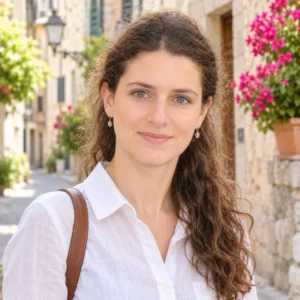
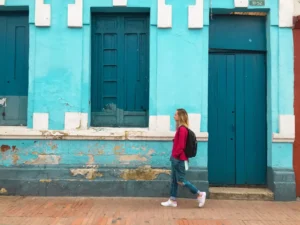
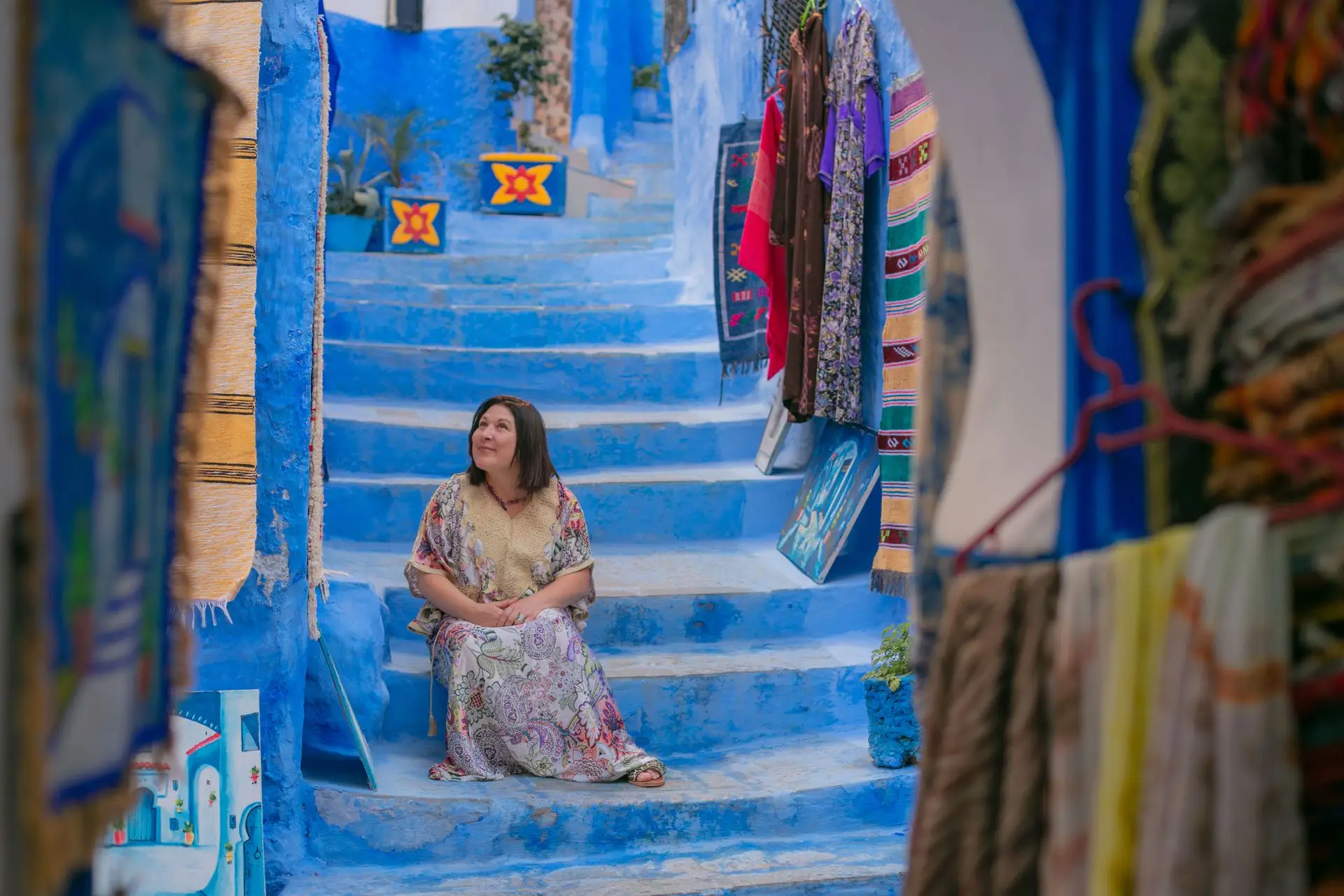
Cities and medinas ask for the full modest baseline: shoulders and knees covered, loose fabrics, nothing tight or revealing. Long skirts, wide trousers and tunics are the standard; jeans are fine, and leggings work under a tunic that covers the hips. Short shorts, mini skirts and crop tops stay for the riad, the pool or the beach.
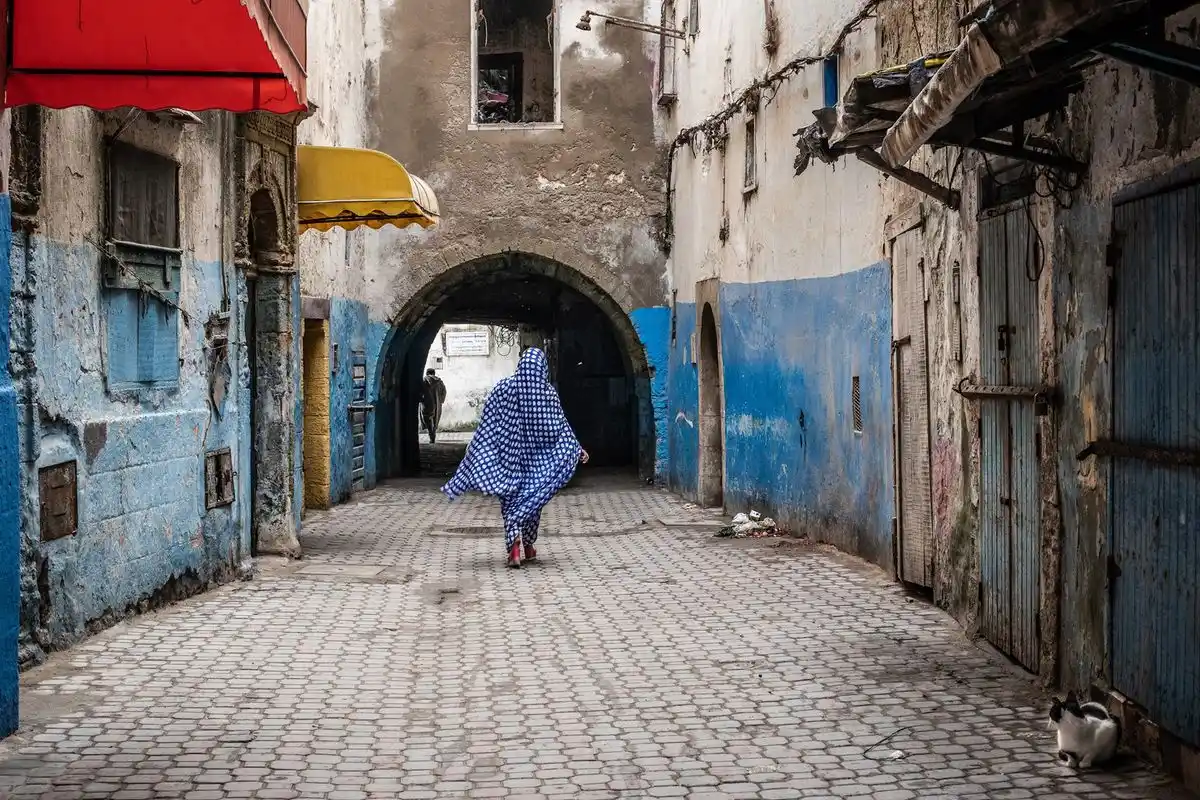
The medina means uneven paving, dust, crowds and motorbikes in narrow lanes, so loose linen trousers, maxi skirts and covered shoulders work for practical reasons as much as respect: they shield you from the sun and the dust. In the modern districts of Marrakech, Casablanca and Rabat, tolerance is higher: shorts, sundresses and sleeveless tops are common on terraces and in hotel lobbies. Walking through the neighbourhood is still more comfortable with a light layer in your bag. The Morocco safety guide gives the same baseline in its dress-code section, and modest dress there is linked to genuinely less unwanted attention.
During Ramadan, dress a notch more modestly than usual: UK government advice notes that clothing which does not meet local dress codes may cause more offence that month. The rule is the same, only the margin for error is smaller.
Wear closed, sturdy shoes for the medina: the lanes are uneven, sometimes slippery, with steps, so leave flip-flops for the riad. Soft babouches, bought locally, suit tiled riad floors and evenings.
The desert
The desert asks for function as much as modesty: loose, long, light layers that cover the skin. A long-sleeved linen shirt, loose trousers, sunglasses and a scarf you can wrap around your head and face cover most of it. Nights are cold, so the warm layer goes in the bag even in summer.
On a camel, wear long trousers, and bring a big cotton scarf for sun and sand. Sahara nights are cool most of the year and can get close to zero in winter, so the warm layer is not optional. A scarf doubles as a dust mask on the drive in and as an extra layer after dark.
Add sunscreen and a wide-brim hat: the sun is the desert’s other hazard, and the scarf alone does not cover it.
Coast, beach and resort pools
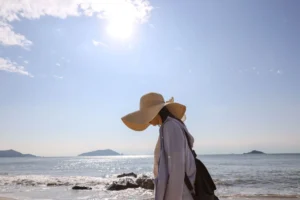
Swimwear is normal on tourist beaches and at resort and hotel pools, in Agadir, Essaouira and Taghazout above all. Bikinis are accepted on the sand and around the pool. Cover up the moment you leave the sand, with a kaftan, sarong or shorts and a top, and keep the swimsuit out of the streets, cafes and medina.
On quieter local beaches, many Moroccan women swim partly or fully clothed, and a foreigner in a very small bikini stands out and can attract unwanted attention. It is not forbidden, but it is not the local norm, so read the beach you are on: if most people around you are covered, a one-piece, a swimsuit with shorts, or a rash vest is the more comfortable choice. Topless sunbathing is not part of beach culture anywhere in Morocco, and Article 483 of the Moroccan Penal Code makes public nudity an offence punishable by one month to two years in prison and a fine, so keep the swimsuit top on, including at most hotel pools. The UK Foreign Office also warns that many Moroccan beaches have limited or no lifeguard cover, with strong currents and unexpected waves, so check the water as well as the dress code. Its Morocco travel advice is the source for both warnings.
Mosques and religious sites
Almost all working mosques in Morocco are closed to non-Muslims, so most travellers never go inside one. The exception is the Hassan II Mosque in Casablanca, open on guided tours. There, cover shoulders, arms and knees, nothing sheer, shoes off, and carry a scarf: covering your hair inside is a courtesy, and a scarf is useful in case it is requested.
The mosque’s published visitor rules ask for clothes that cover the shoulders and torso and come below the knees, forbid shorts and sleeveless clothes outright, and ask visitors to take off their shoes. The rules do not mention a headscarf, but covering your hair inside is a simple mark of respect, and carrying a scarf means you are ready if you are asked. Historic madrasas, like the Ben Youssef madrasa in Marrakech, are open to visitors as monuments: nobody usually checks what you are wearing at the door, but covered shoulders and knees are expected, and hats come off inside. In daily life, foreign women are not expected to cover their hair anywhere in Morocco, and the UK government’s travel advice says nothing about hair at all.
Evenings and the mountains
Evenings are cool, and the mountains are cooler still. A light cardigan or layer goes in the bag for air-conditioned restaurants and for evenings after a hot day. In the High Atlas villages around Imlil, long loose clothing is strongly advised, and a tee with sleeves keeps you comfortable on a hike.
Marrakech afternoons run to about 37 degrees in July and August, with nights near 20, so loose cotton or linen that covers shoulders and knees is cooler in strong sun than shorts and a vest: modesty and comfort point the same way. Rooftop bars and upscale restaurants in the modern districts see dresses, jumpsuits and heels, but the walk there still passes through streets where a light layer earns its place.
One more wardrobe note, for the hammam: in a public neighbourhood hammam, men and women bathe separately, and women usually keep their underwear bottoms on. In tourist and hotel spas, disposable underwear is usually provided, so follow the staff’s lead. Pack the swimsuit for the pool, not the hammam.
In winter, the warm layer becomes a fleece or a down jacket, with warm socks: snow is common on the Atlas passes from December to March, and desert nights then sit near freezing.
The packing capsule
The whole wardrobe fits in a short list: long skirts, wide trousers and tunics, linen shirts that cover the shoulders, a large light scarf, flat shoes for the medina cobblestones, and a warm layer. Linen, light cotton, rayon or bamboo breathe in heat over 30 degrees; heavy polyester traps heat and clings.
What stays home is as short as the list: heavy denim, tight clothes, sheer fabrics, and heels. Heavy denim is hot and slow to dry; tight clothes draw the attention the rest of the wardrobe avoids; sheer fabrics need a layer underneath, which defeats the point of packing them.
| Item | Why it earns its place |
|---|---|
| 2 long skirts or wide trousers | The modest baseline for cities, medinas and villages |
| 3 linen shirts or tunics | Cover the shoulders; light enough for heat over 30 degrees |
| 1 large light scarf | Sun shield, dust mask, shoulder cover, mosque wrap, warm layer |
| 1 dress, knee-length or longer | Evenings and modern districts; pairs with the cardigan |
| 1 light cardigan or layer | Evenings, air conditioning, mountain villages |
| Flat shoes or trainers | Medina cobblestones; heels are impractical there |
| 1 swimsuit and 1 cover-up | Tourist beaches and resort pools; cover-up for the walk back |
The carry-on packing list pairs with this capsule: the whole wardrobe above fits one cabin bag, and the list covers how to pack it.
At a glance
Each place takes a different outfit: cities and medinas take the modest baseline; the desert takes layers and a scarf; the beach takes swimwear on the sand and a cover-up off it; the mosque takes full cover and a scarf ready.
| Place | What to wear | What to avoid |
|---|---|---|
| Cities and medinas | Long skirts, wide trousers, tunics, linen shirts | Short shorts, mini skirts, crop tops, sheer fabrics |
| Desert | Long-sleeved linen shirt, loose trousers, scarf, warm layer | Shorts, sleeveless tops, no scarf |
| Beach and resort pools | Swimwear on the sand; kaftan or sarong off it | Swimwear in the streets, cafes and medina; topless sunbathing |
| Mosques (Hassan II) | Shoulders, arms and knees covered; scarf ready; shoes off | Shorts, sleeveless clothes, sheer fabrics |
| Evenings and mountains | Light cardigan or layer; long loose clothing | Going out with no layer at all |
How this guide was made
Research-based. No trip is claimed. The dress-code facts were checked against the live Day 4 Morocco guide and multiple independent sources on 23 November 2026. The safety picture, including the advisory, lives in the Day 4 guide.
FAQs
No in daily life. Only inside a mosque that admits visitors, such as the Hassan II Mosque, where covering your hair is a courtesy and a scarf is useful in case it is requested. Carry a scarf.
No. No law requires visitors to cover fully or wear a headscarf. Modest dress is expected courtesy: shoulders and knees covered in towns, medinas and villages.
Yes, on tourist beaches and at resort and hotel pools. Cover up off the sand, in streets, cafes and the medina. On quieter local beaches a one-piece or rash vest is the more comfortable choice.
In resort areas and modern districts, yes. In medinas and villages, knee-length linen bermudas or culottes; short shorts attract attention and comments.
Shoulders, arms and knees covered, shoes off, and a scarf ready for your hair. Most other mosques are closed to non-Muslims.
Loose, long, light layers, a long-sleeved linen shirt, loose trousers, sunglasses and a scarf for sun and dust, plus a warm layer for cold nights.
Linen, light cotton, rayon or bamboo breathe in the heat. Heavy polyester holds heat and sticks, so leave it out of the capsule.