

Is Goa Safe for Solo Female Travellers? The Short Answer
Goa is one of India’s most comfortable solo destinations for women, and it is still not risk-free. The US State Department rates India Level 2, exercise increased caution, dated 16 June 2025, and Goa is not named in the US summary, while the UK and Canada both flag women-specific vigilance in Goa. Serious incidents involving tourists have happened in Goa, so day-to-day travel feels manageable with protocol, and the risk concentrates at night, in isolated places, and around alcohol and transport. The sections below cover the advisories, the north-south split, and the practical rules that make a solo trip work. For another Indian city with the same advisory pattern, see our Jaipur safety guide.
What the Advisories Actually Say About Goa
The advisories agree on the shape of the risk, and they disagree on nothing that matters for Goa. The US State Department rates India Level 2, exercise increased caution, dated 16 June 2025, citing crime and terrorism, and the US summary names rape as one of the fastest growing crimes in India and says sexual assault happens at tourist sites. Goa is not named in the US summary, and Goa is not in the US higher-risk zone, which covers eastern Maharashtra and northern Telangana through western West Bengal. The UK Foreign Office gives Goa its own entry: opportunistic criminals operate there because of the high number of tourists, and the UK reports serious incidents involving British nationals, including sexual assaults. Goa is outside the areas the UK advises against, so the warning is about vigilance, not about staying away.
Canada names Goa as a place where women travellers should be especially vigilant, alongside Delhi, all public transport, and yoga centres, ashrams and spiritual retreats, and Canada says reports of rape and assault against foreign women have increased. India ranks 127th of 163 countries on the Global Peace Index 2026, down from 115th in 2025, and the decline was driven by conflict indicators, tensions with Pakistan and Myanmar, and violence in Manipur. That is a national figure, not a Goa figure, and it is the reason the advisories read the way they do. No advisory tells women to avoid Goa, and none should be read as one. The honest reading is simple: Goa is one of India’s most comfortable solo destinations for women, and it is still not risk-free. Nepal sits in the same advisory region, so compare it in our Nepal safety guide.
North Goa: Social, Busy and Best for Meeting People
North Goa is the social half, and it is the half to pick when the trip is about people. Anjuna, Vagator and Assagao form the belt where the hostels cluster, the flea markets run, and the nights stretch late. Anjuna market runs on Wednesdays, the Saturday night bazaars draw the crowds, and the cliff bars above Vagator fill at sunset, with travellers, music and cheap drinks. The hostel density is the reason North Goa works for a solo woman: the common rooms, the group walks and the shared taxis mean a first night in a new place is never a lonely one, and the streets stay busy until late, with people, shops and cafes on every corner.
The practical case for North Goa is the company. Book a hostel with a women-only dorm, a lock on the door, a locker in the bed, and a host on site, and read reviews from solo female travellers before booking. The markets are the daytime anchor, and the cliff bars are the evening anchor, so the days have a shape and the nights have a place to go. A woman alone in North Goa in the evening is one of many people on the same street, eating, shopping and walking, and that is the safety of the crowd. North Goa suits the first half of a trip, when the plan is to meet people and find the rhythm, and then South Goa is the place to reset.
South Goa: Calm, Quiet and Best for a Reset
South Goa is the calm half, and it is the half to pick when the trip is about rest. Palolem, Agonda and Patnem are long quiet beaches, with yoga in the morning, early nights, and streets that empty by ten. The pace is slower than the north, with the restaurants closing early and the beaches quiet after dark, and a woman alone in South Goa in the evening is walking home through a village that feels residential, not touristy, and that is the charm of it. The area suits a reset, when the plan is to sleep well, read, swim and do nothing, and the days are shaped by the beach and the yoga mat rather than the market and the bar.
The practical case for South Goa is the quiet. Book a place near the beach, because the walk home at night should be short and lit, and check the walk in daylight before the first night, because the lanes are dark and the route should be known. Pick a guesthouse with a host who answers messages, a lock on the door, and a locker in the room, and read reviews from solo female travellers before booking. The honest advice most guides give is to do both: north first for the scene, then south for the reset, because the two halves of Goa are different trips in one state, and a solo traveller who does both gets the full picture.
Panaji and the Baga-Calagute Strip: The Urban Base and the Transit Strip
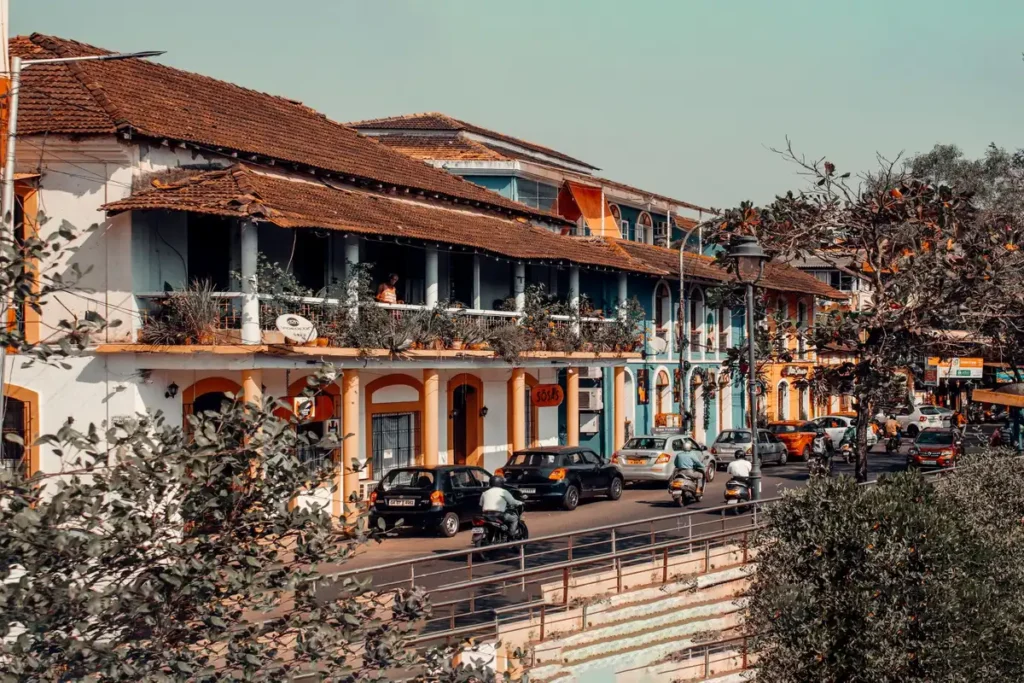
Panaji is the urban base option, and it is the base to pick when the trip needs a city. The capital is well connected, with buses, taxis and the airport run, and the Fontainhas heritage walks are the reason to stay, with old Portuguese houses, small cafes and quiet streets in the Latin quarter. Panaji suits a first night or a last night, when the plan is to arrive, settle, and move on, and it is the base that makes the logistics easy. The streets are busy by day and quiet by night, with the restaurants closing early and the riverfront emptying by ten, so the evenings are calm and the mornings start slowly.
Baga and Calangute are the package-tour strip, and solo travellers mostly transit them. The beaches are crowded, the shacks are loud, and the streets are full of tour groups, so the area is the place to pass through, not to base in. A woman alone in Baga in the evening is one of thousands of people on the same beach, and the crowds are the safety, but the strip is not the Goa most solo travellers come for. The rule is short: base in the north for the scene, base in the south for the reset, base in Panaji for the logistics, and transit Baga and Calangute on the way between them.
The Real Risks: Night, Isolated Beaches, Drink and Scooters
The real risks in Goa concentrate in four places, and they are the ones this section names plainly. Night is the first: avoid isolated beaches or areas late at night, because the risk is highest when the streets are empty and the lights are off. Drink is the second: watch your own drink, keep a trusted ride home arranged, and share your location with a hostel friend, because drink spiking happens in Goa as it does in every party town. Transport is the third: agree a firm taxi price before getting in, use the GoaMiles app for fixed-rate bookings, and never take an unmarked car at night. Scooters are the fourth: the rules are non-negotiable, with a valid licence on you, a helmet always, a photograph of existing scratches at pickup, and never hand over your original passport or licence as deposit.
Beach safety is the risk most travellers underestimate, and it deserves its own line. Strong currents and drowning risk are real in Goa, so swim only at lifeguarded, populated stretches, respect the flags, and do not swim at isolated beaches at night. Cover-ups are the rule for village and market walks, because the villages are conservative and the markets are crowded, and a covered shoulder draws less attention than a bare one. Drinking on an open beach or road is illegal in Goa, so keep the drink inside the shack and the bottle out of sight. The season matters too: November to February is peak, with drier weather and most beach towns fully open, October and March are the shoulders, and the monsoon from June to September is a different, quieter Goa.
Practical Rules for a Safe Solo Trip in Goa
The practical rules are short, and they are the ones that make the trip work. Agree a firm taxi price before getting in, and use the GoaMiles app for fixed-rate bookings, because the meter is the exception and the negotiation is the rule. Keep a trusted ride home arranged before going out, and share your location with a hostel friend, because a known ride home is the safety net at night. Keep valuables minimal, with the phone zipped away and the wallet in a pocket, and prefer populated beach stretches, because the crowds are the safety. The emergency number in India is 112, for police, ambulance and fire, and it is free to call, so save it in the phone before the trip, along with the hostel address.
The scooter rules are the ones that matter most, because the scooter is the most common way to get hurt in Goa. A valid licence on you, a helmet always, a photograph of existing scratches at pickup, and never hand over your original passport or licence as deposit: those four rules are non-negotiable, and a hire shop that asks for an original document is a shop to walk away from. The drink rules are the same as everywhere: watch your own drink, buy it yourself, and never leave it with a stranger. The night rules are the same as everywhere: stay on populated stretches, keep a trusted ride home arranged, and share your location with a hostel friend. Goa is a place that rewards a plan, and a solo traveller with a plan has an easy trip. To see where Goa sits in the wider ranking, read our safest countries guide.
FAQs: Is Goa Safe for Solo Female Travellers?
Goa is one of India’s most comfortable solo destinations for women, with protocol, and it is still not risk-free. Incidents involving tourists have happened, so the risk concentrates at night, in isolated places, and around alcohol and transport. No advisory tells women to avoid Goa.
North Goa is best for social travel, with hostel density, flea markets and nightlife, and South Goa is best for calm, with long quiet beaches, yoga and early nights. Many travellers do north first for the scene, then south for the reset, because the two halves of Goa are different trips in one state.
The US State Department rates India Level 2, exercise increased caution, dated 16 June 2025, citing crime and terrorism. Goa is not singled out in the US summary, and it sits outside the US higher-risk zone, which covers eastern Maharashtra and northern Telangana through western West Bengal.
The UK gives Goa its own entry: opportunistic criminals operate there because of the high number of tourists, and the UK reports serious incidents involving British nationals, including sexual assaults. Canada names Goa as a place where women travellers should be especially vigilant, and says reports of rape and assault against foreign women have increased.
Avoid isolated beaches and areas late at night, and prefer populated stretches, because the risk is highest when the streets are empty and the lights are off. Keep a trusted ride home arranged, and share your location with a hostel friend. The streets in the north stay busy until late, and the south empties by ten.
Only with a valid licence on you, a helmet always, and a photograph of existing scratches at pickup, and never hand over your original passport or licence as deposit. Those four rules are non-negotiable, and a hire shop that asks for an original document is a shop to walk away from.
November to February is peak, with drier weather and most beach towns fully open. October and March are the shoulders, with fewer crowds and most places open. The monsoon from June to September is a different, quieter Goa, with heavy rain and many beach towns closed.