

The Road to Hana Maui is Hawaii’s most famous scenic drive — 64 miles of waterfalls, black sand beaches and one-lane bridges. This is the honest, stop-by-stop guide: which stops earn your daylight, which to skip, and how to plan a day that actually works.
Is the Road to Hana Maui Worth It?
Yes — the Road to Hana Maui is worth it for its waterfalls, black sand beaches and rainforest drive, but only if you leave by 7am, book Waiʻanapanapa in advance, and pick five to seven stops rather than rushing all of them in one long day.
| Detail | What to expect |
| Distance | ~64 miles one-way (Kahului to Hana town) |
| Drive time | 2.5–3 hrs without stops; 10–12 hrs roundtrip with stops |
| Best departure | 7–8am, to beat tour buses and afternoon rain |
| The road | 620 curves, 59 one-lane bridges — narrow but paved throughout |
| Reservations | Required for Waiʻanapanapa State Park (mile marker 32) |
| Petrol | Fill up in Kahului or Paʻia — no gas stations across ~50 miles to Hana |
| Car | A standard rental car is completely fine |
What You Need to Know Before You Drive
Here is the thing nobody tells you plainly: this is a winding road, not a motorway. It threads along the coastline with 620 curves and 59 one-lane bridges, and yes, that sounds terrifying on paper. But the paved road is surprisingly well maintained, so take your time and you will be fine. The drive is famous for being more about the journey than the final destination, and that framing matters. You are not racing to Hana town; you are collecting the moments between.
Those moments live at the pull-offs. There are dozens of pullouts where you can overlook waterfalls and tucked-away beaches, which is exactly why this counts among the best things to do in Maui. The trouble? Too many stops, not enough daylight. You genuinely cannot see them all in a day, so you must select stops with intention.
Sort the Logistics First
Get these three right and the day runs itself.
- Petrol: Fill up in Kahului or Paʻia before you set off. There are no gas stations across the roughly 50 miles between Paʻia and Hana town.
- Car: A standard rental car handles the whole route. You do not need anything rugged or four-wheel-drive.
- Reservations: You must book in advance for Waiʻanapanapa State Park, the famous black sand beach at mile marker 32, through Hawaiʻi’s DLNR state parks system. Popular pulloffs fill before 9am, so an early departure is not optional if you want parking.
A Word on Comfort and Car Sickness
Let me be straight, woman to woman. The constant curves trigger motion sickness fast, and I would rather warn you than watch you suffer. If you or anyone in your group gets car sick, take medicine like Dramamine before you start, not after the queasiness hits. Travellers consistently report it keeps them comfortable throughout. Treat the departure time as sacred, respect the road, and the rest follows.
Should You Drive the Road to Hana Maui Yourself or Take a Tour?
Drive yourself if you want to stop wherever you like, move at your own pace, and stay overnight in Hana. Take a guided tour if you get carsick, feel nervous about the curves, or simply want to relax and let someone else handle the road. This is the first decision that shapes your whole day.
The Case for Driving Yourself
Self-driving gives you freedom, and for a solo woman that freedom is the whole point. You linger at the viewpoint everyone else rushes past, skip the one that does nothing for you, and pull over for banana bread on a whim. The catch is that you are the one watching 620 curves and 59 one-lane bridges instead of the scenery. That is where the clever middle path comes in: a self-guided GPS audio tour like Shaka Guide narrates the drive, tracks your location, and tells you what to see at the right moment, with no stranger in the car.
The Case for a Guided Tour
Hand the keys to an expert local guide and the stress evaporates. A good guide also takes you only to approved, safe, legal spots. Here is a point worth sitting with: tourism has overwhelmed the local community, and one van instead of a dozen cars genuinely eases pressure on the Hana Highway. The Hawaiʻi Tourism Authority has repeatedly urged visitors to tread more lightly, and fewer vehicles is a real part of that.
What It Costs in 2026
Prices reflect typical 2026 rates. Confirm current pricing before you book.
| Option | Rough cost | Duration | Best for |
| Self-drive | $0 + car rental | 10–12 hrs | Flexibility, going at your own pace |
| GPS audio app | ~$24.99 | Self-paced | Narration without a guide in the car |
| Guided van tour | 150–250 per person | 10–12 hrs | No driving stress; pickup, narration, lunch included |
| Luxury private tour | 500–1,000+ | Customised | A tailored trip, couples, special occasions |
| Helicopter flyover | 250–400 per person | 45–60 minutes | Seeing the coast from above, short on time |
Note the guided van tour usually bundles in pickup from Kahului, Wailea or Kaʻanapali, so factor that convenience into the cost. There is no wrong answer here, only the one that fits how you travel.
When to Start the Drive (and Why Early Really Matters)
Leave by 7am, or even 6am. An early departure puts you ahead of the tour buses, the afternoon rain, and the crowds, and it gets you to the parking lots before they fill. This single choice makes or breaks the entire day.
This is not scare-mongering. One traveller described arriving later and meeting aggressive flaggers waving cars onward, shouting “no room, keep going!” at every full lot. After about 20 miles of being unable to stop anywhere, she gave up and went home. A late start genuinely cost her the day.
The Crowd Window Is Predictable
Most visitors reach the official start between 8 and 9:30am. Get there by 7 and you stay ahead of that wave. Here is roughly what your day looks like depending on when you set off.
| Departure | What to expect |
| 6–7am | Open parking, quiet bridges, the best light later in the morning |
| 8am | Busier, but still manageable if you keep moving |
| 9am or later | Full lots, flaggers waving you on, real risk of being turned away |
Don’t Forget the Drive Back
There is a safety reason to start early, too. The road narrows to one lane at numerous bridges, often on hairpin corners, and you never want to be navigating those in the dark.
- Begin heading back no later than 3pm.
- Allow yourself about three hours to return before conditions get stressful.
- Treat sunset as a hard deadline, not a loose suggestion.
The difference between a magical day and a wasted one usually comes down to the hour you left the hotel.
The Best Stops on the Road to Hana, Mile by Mile
Not every pull-over is worth your precious daylight. These first three stops set the tone: one to skip, one that depends on you, and one you should not miss.
Twin Falls (Mile 2) — Popular, but Overrated
Is Twin Falls worth it? Honestly, no. Sitting right at mile marker 2, it is the first real stop most people reach, and that is exactly its downfall. The cars pile up here by the dozen first thing in the morning. Compared with the waterfalls and beaches waiting further along, this is the biggest time-waster on the whole drive. The friendly fruit vendors are a genuine charm, but the falls themselves do not justify the parking scramble. If you are tight on daylight, skip it and keep going.
Waikamoi Ridge Trail & the Rainbow Eucalyptus (Mile 7–9.5)
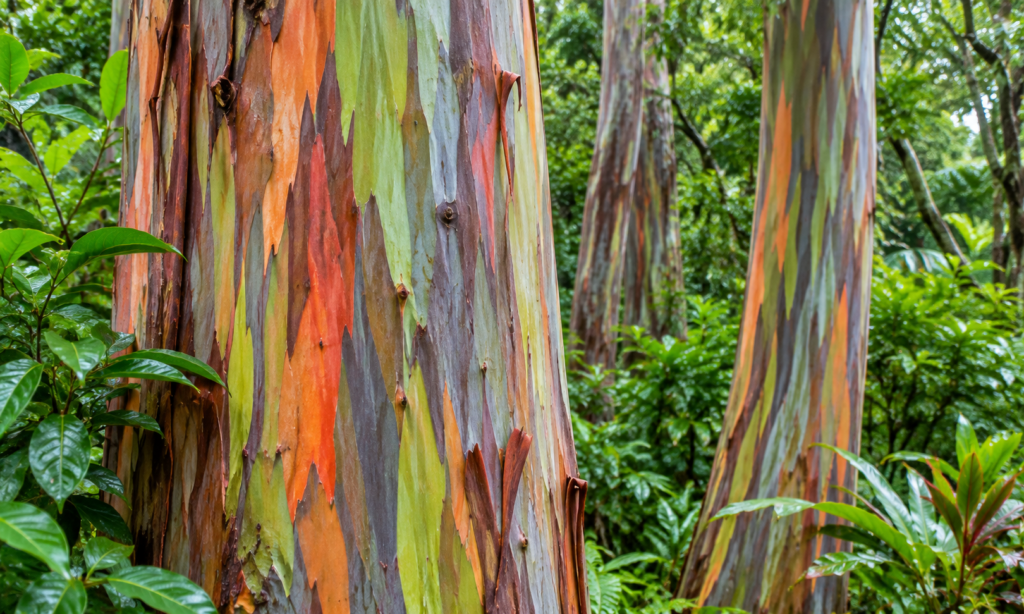
Around mile marker 9.5, the Waikamoi Ridge Trail offers a short stroll through lush rainforest. There is no waterfall here, just dense greenery, so be honest about whether that appeals. Love forest walks? It is a peaceful leg-stretch. Not fussed by trees? Give it a miss. Either way, keep your eyes open nearby for the famous rainbow eucalyptus trees, named for their extraordinary bark in streaks of orange, green and brown. It is a quick roadside stop, but a surprisingly photogenic one that too many visitors drive straight past.
Garden of Eden Arboretum (Mile 10.5)
Now a stop I would tell any friend to keep. The Garden of Eden Arboretum at mile marker 10.5 is one of the finest gardens on Maui and a genuine must-see.
| Detail | What to know |
| Admission | Around $20 per person (confirm current rate) |
| Worth the fee? | Yes — the grounds are meticulous |
| What you see | Panoramic Pacific overlooks and a clear view of Puohokamoa Falls |
Admission feels a touch steep at first glance, but you are paying for an ocean overlook that stops you mid-sentence. The founder of a leading Hawaii travel guide rates this among his top three stops on the entire route, and once you stand at the lookout, you understand why.
More of the Best Stops, Mile by Mile
The middle stretch is where the drive truly opens up: your first jaw-dropping coastal view, the most beloved snack stop, and a waterfall you can admire without leaving the tarmac.
Honomanu Bay Lookout (Mile 14)
At mile marker 14 you reach the Honomanu Bay Lookout, a proper must-see. The reward is the sight of the Hana Highway snaking across the green cliffside, with the bay glinting far below. Now the insider tip that saves your photo. Most people stop at the first pull-off and come away disappointed, because the nearest ones are obstructed by trees. Instead, use the large mauka (inland) pullout about four-tenths of a mile past mile marker 14. That is the spot with the clear, unobstructed angle.
Keʻanae Peninsula & the Halfway to Hana Stand (Mile 16–17)
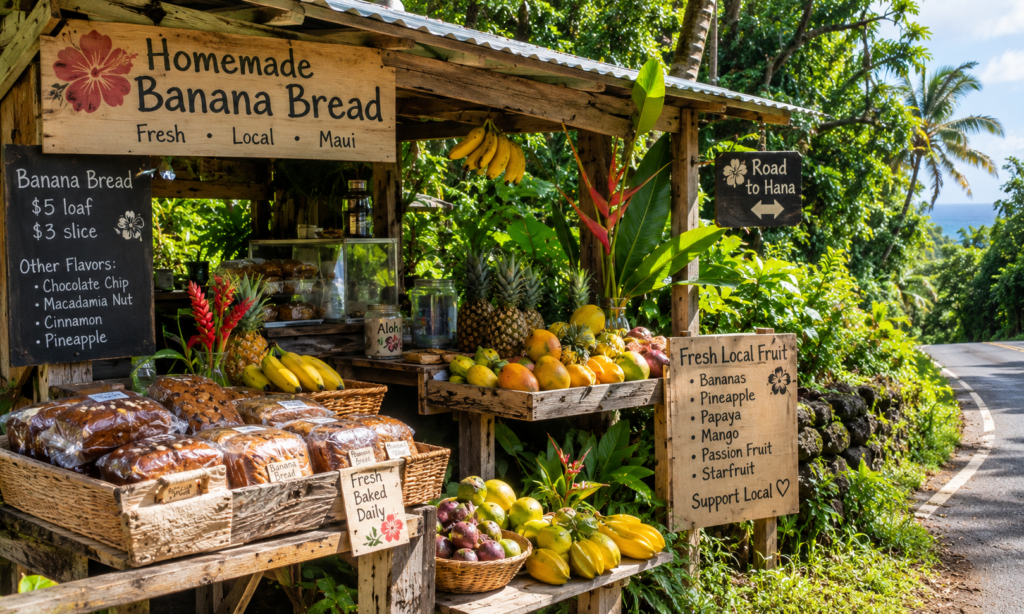
Just past mile marker 16, the Keʻanae Peninsula hands you dramatic coastal views while you stand on one of Haleakala’s most recent lava flows. It is raw, black and quietly humbling. A short way on, at mile marker 17, sits the famous Halfway to Hana stand. Here is what this little shop serves:
- Homemade banana bread (it claims to be the home of the original)
- Shave ice, fresh fruit and cold drinks
- Proper hot food, including a BBQ pork sandwich or a hot dog
If you only eat at one roadside stop all day, make it this one.
Upper Waikani Falls — “Three Bears” (around Mile 19)
Around mile marker 19 you will spot Upper Waikani Falls, far better known as Three Bears for its trio of side-by-side cascades. It is one of the more impressive waterfalls you can take in straight from the roadside, with no hiking required. One word of caution: the pull-off is small and parking is tight, so approach slowly and only stop if it is genuinely safe. A photo is never worth a scrape on a blind bend.
The Final Stretch of Stops Before Hana
One stop is really just a loo break, one demands a reservation you must sort weeks ahead, and one is honestly a bit of a letdown.
Puaʻa Kaʻa State Wayside (Mile 22.5)
My honest answer is mixed. At mile marker 22.5, a gentle five-minute walk from the car park takes you to a small waterfall, reached by picking your way across a rocky stream. It is pretty enough, but not worth a special detour on its own. What makes it genuinely useful is the restrooms and a chance to stretch your legs halfway through the drive. One safety word: flash-flood risk is real when you cross the stream, and loose rocks can fall after heavy rain.
Waiʻanapanapa State Park & the Black Sand Beach (Mile 32)
Now the big one. Waiʻanapanapa State Park at mile marker 32 is the famous black sand beach, and for many travellers it is the single best stop on the whole drive. The bay is stunning, the waves crash in dramatically, and short trails wind around the cliffs. But here is the rule you absolutely cannot ignore.
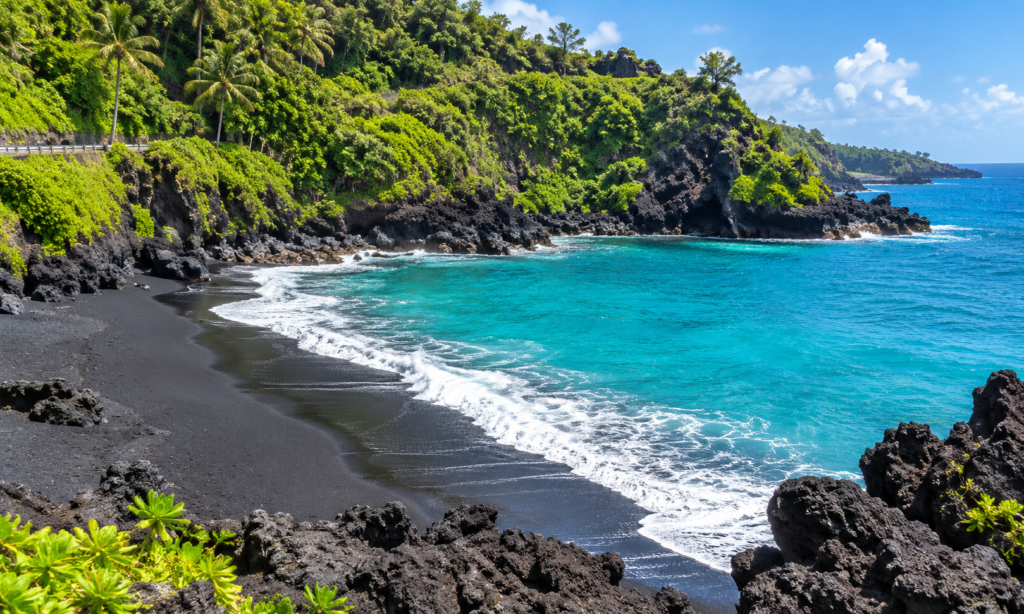
| Need to know | Detail |
| Reservation | Required for non-residents, booked in advance via Hawaii’s DLNR |
| Cost | About $5 per person entry + $10 per vehicle to park |
| Same-day entry | Not allowed; book up to 30 days ahead |
| Car park | Fills fast — choose an early slot |
I read about one woman who skipped the booking, turned up hopeful, and was turned away right at the entrance. Do not be her. Sort your timed reservation before you leave home and pick a morning slot.
Hana Town — What’s Actually There (Mile 34)
I will be straight with you: Hana town at mile marker 34 can feel like a bit of an anticlimax. Beyond a few small stores and a general store for supplies, there is not a great deal to see. It is quaint and welcoming, worth a quick look, but do not expect a bustling resort town. If you still have daylight, keep heading toward Kipahulu, where the real rewards are waiting.
The Best Stops Beyond Hana Town
Here is the secret most day-trippers miss: the finest stops come after Hana, not before it. If you have the daylight, this is where the drive saves its best for last.
Hamoa Beach & Wailua Falls (Mile 45–51)
Push past Hana town and the road rewards you twice over. Hamoa Beach, reached by turning makai (toward the sea) onto Haneoo Road near mile marker 51, is arguably the prettiest beach on Maui. It is a perfect crescent of sand tucked below the cliffs. Parking gets tough later in the day, so arrive early. A little further along at mile marker 45 sits Wailua Falls, which drops around 80 feet right beside the road. It counts among the most scenic and easily accessible waterfalls in all of Hawaii. Take the short walk down for a closer look, because this one genuinely earns the stop.
Oheʻo Gulch & the Pipiwai Trail (Seven Sacred Pools, Mile 42)
Save your energy for this one, because it is the big reward. Oheʻo Gulch, often called the Seven Sacred Pools, sits at mile marker 42 inside Haleakala National Park, so you will pay the national park fee to enter. One thing to know before you get your hopes up about a swim: the pools are closed to swimming for safety reasons. The real draw is the Pipiwai Trail.
| Pipiwai Trail | Detail |
| Distance | About two miles one way |
| Time to budget | One to four hours |
| Highlights | A towering bamboo forest and a massive banyan tree |
| The finale | 400-foot Waimoku Falls |
Let me be honest, because that is my whole promise to you. Some falls run dry in a drought, and a long hike to a trickle can disappoint. Check the recent weather before you commit the hours. But time it after a good rain, and the walk through that bamboo tunnel to Waimoku Falls is the moment you will remember long after the curves fade from memory.
Stops Worth Skipping (and How to Save Your Daylight)
Skip Twin Falls at mile marker 2, treat Kaumahina State Wayside as a restroom break only, and don’t waste the long Pipiwai hike on a drought week. Daylight is your scarcest resource here, so spend it on the genuine highlights.
Here is the section the pretty listicles refuse to write. The biggest mistake visitors make is following the crowd. If you see a dozen cars pulled over, that does not mean the spot is special. More often, one person stopped, and everyone simply copied them. Trust your plan, not the clump of cars.
The Stops You Can Safely Skip
- Twin Falls (mile marker 2): the first and most tempting trap, and the biggest time-waster on the whole drive.
- Kaumahina State Wayside: worth it only if you need the restrooms, because the views ahead are better.
- Puaʻa Kaʻa: a loo-and-lunch stop, not a scenic highlight. Pause for the toilets, then move on.
Manage Your Expectations on the Waterfalls
The waterfalls are glorious when they flow, but some run dry in a drought, and a dead cascade is a sad thing to drive for. One traveller found Makahiku Falls completely dry on her visit, and even the celebrated Waimoku Falls left her underwhelmed after a long hike. So be realistic. Check the recent rainfall before you commit hours to the weak ones, and pour that saved time into the stops that truly deliver.
Is the Road to Hana Dangerous? Driving Tips & Motion Sickness
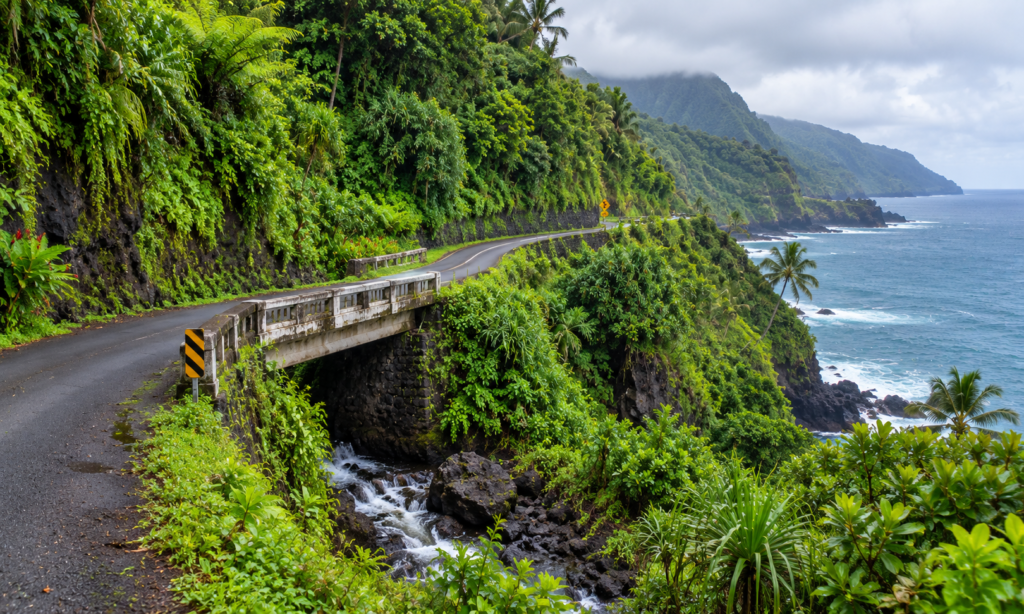
Not really. As long as the driver stays alert and takes it slow, this drive is very manageable. The route is fully paved the whole way, so any standard car handles it. The real challenges are the sheer number of curves, the 59 one-lane bridges, and a few sections with no guardrails, not the road surface itself.
Driving Tips That Keep the Day Calm
- Take the curves slowly, especially in the rain when the tarmac turns slick.
- Honk lightly before blind corners so oncoming cars know you are coming.
- Yield politely at the bridges. The road narrows to one lane at many, often on hairpin bends, so wait your turn.
- Let impatient local drivers pass. Pull over and wave them by instead of speeding to keep up.
- Rotate drivers when you can, so nobody is stuck watching the road all day.
- Never drive it in the dark. Fading light plus those bridges is a combination to avoid.
Beating Motion Sickness
All those bends can turn your stomach fast, and feeling queasy ruins even the prettiest scenery. My honest advice, especially if you travel solo and are the one driving: prepare before you set off, not after.
- Take medicine such as Dramamine before you start, not once the queasiness hits.
- Sit in the front and keep your eyes on the horizon rather than your phone.
- Pack ginger sweets as a gentle backup.
One final warning worth its weight in gold. There is no cell service for long stretches, so download your offline maps and an audio guide before you leave your hotel Wi-Fi.
What to Pack (Your Checklist)
Bring a packed lunch, plenty of water, cash in small bills, comfortable shoes you don’t mind getting muddy, a rain poncho, bug spray, and offline maps downloaded in advance. A little packing the night before makes the whole day smoother.
Food, Water & Keeping Cool
- A packed lunch in a small backpack, which you’ll also want for walking to reach some of the sights.
- Plenty of water — more than you think you need in the heat.
- A cheap cooler with ice to keep your food and drinks cool through a long, warm day.
Cash, Shoes & Weather
Here is the detail that trips people up most: cash. Many fruit stands, smoothie vendors and roadside stalls are cash-only, so withdraw small bills before you leave town.
- Comfortable shoes you don’t mind getting muddy — never your pristine white trainers, since short hikes are part of the fun.
- A rain poncho, because quick showers are common along this lush coast.
- Bug spray, just in case the mosquitos are out when you stop.
Protect Your Valuables
Do not forget your camera, but do not leave it on display in the car either. Break-ins still happen, so keep anything valuable — your phone, camera or tablet — tucked in that backpack and with you. Sort these small things the night before, and nothing catches you out once you’re on the road.
Where to Find Bathrooms, Gas & Food
Fill up in Paʻia or Kahului before you start, as there’s no petrol for the ~50 miles to Hana. Public toilets sit at Kaumahina and Puaʻa Kaʻa waysides. For food, the roadside stands sell banana bread, ice cream and more.
Fuel Up Before You Go
There are no gas stations across the roughly 50 miles between Paʻia and Hana town. Fill the tank in Kahului or Paʻia before you start, because prices in Hana itself are eye-watering if you limp in on empty. Treat Paʻia as your last reliable fuel stop.
Where to Find a Loo
| Where | What you’ll find |
| Kaumahina State Wayside | Public toilets, roughly mid-drive |
| Puaʻa Kaʻa State Wayside | Public toilets, a handy halfway break |
| Hana Lava Tube | Porta-potties with water and soap |
| Pipiwai Trail car park | Public restrooms beyond Hana |
The Food Stops Are Half the Joy
- Halfway to Hana stand — homemade banana bread, the classic.
- Coconut Glen’s — vegan ice cream in the middle of the rainforest.
- Hana Gold Cacao plantation — chocolate made where the cacao grows.
- Aunt Sandy’s — yet more banana bread, and worth it.
Many of these little stops are cash-only, so keep small bills handy. There’s nothing sadder than standing at a banana bread counter with only a card.
One Day or Two? Should You Stay Overnight in Hana?
One day suits most people: leave Kahului by 7 or 8am, hit five to seven of the best stops, and return the same way. Stay overnight only if you hate early starts, have time to spare, and don’t mind pricey Hana hotels.
The One-Day Trip (the Classic Approach)
- Efficient — you return the way you came and cover the highlights.
- Rushed — the pace is tight, and you get little time in Hana itself.
- Tiring — that afternoon drive back can feel long after a full day.
For a confident traveller who’s happy with an early alarm, one well-planned day is plenty.
The Two-Day Trip (the Slower, Richer Option)
Give it two days and the whole character of the trip softens. You drive leisurely, linger at every stop, and arrive in Hana by mid-afternoon with time to explore the town and quieter beaches. The real prize? Staying overnight means you reach the best sights, like Waiʻanapanapa or the Pipiwai Trail, before the day-trippers arrive, plus a peaceful sunrise all to yourself.
So, Is It Worth Staying?
If you hate early mornings and long days, then yes, a night in Hana is a kindness to yourself. But be realistic about the trade-offs:
- Hotels in Hana are limited and expensive, so your budget takes a hit.
- There’s not a lot to do in the town itself once you’ve seen it.
- Lodging sells out fast, so book far ahead or you’ll find nothing left.
For many women travelling solo, one carefully planned day gives you the whole experience without the extra cost.
Driving the Back Road (the Route in Reverse)
Should you drive the Road to Hana in reverse? Only if it’s your second trip. The back way starts from Upcountry Maui through Kaupo and reaches Hana from the south, skipping the crowded highway. It rewards you with quiet, but the rough, unpaved section near Kaupo makes it a poor choice for first-timers.
The Appeal
- Far less traffic, since most people drive the standard way.
- A fresh perspective on stops you may have seen before.
- Early-morning arrivals at Oheʻo Gulch and Waiʻanapanapa, before the crowds roll in.
For a return visitor who already knows the sights, that early quiet can be pure magic.
The Drawbacks (and They’re Serious)
| Watch out for | The reality |
| The surface | A rough five-mile unpaved section past Kaupo |
| The edges | Narrow lanes with no guardrails above steep cliff drops |
| Your rental | Most companies prohibit this road, so any damage is out of your own pocket |
| Connectivity | No cell service for long stretches, and no gas between Upcountry Maui and Hana |
So, Who Should Actually Do This?
Not first-timers. If this is your first drive, take the standard route. The mile markers, the guides, and the whole experience are built around going the usual way. Save the reverse loop for a second trip, once you already know the stops and fancy seeing them in a quieter, wilder light.
Respecting Hana — Travelling Pono on the Highway
Travelling pono means parking only in designated stalls, staying off private property, keeping out of streams in heavy rain, and taking your rubbish with you. Hana is a living community, not a theme park, and tourism has genuinely overwhelmed the area. How you behave on this drive matters to the people who call it home.
Mind Where You Park (the Fines Are Real)
The state has installed around 70 “no parking” signs along the highway, and the penalties are not trivial.
| Offence | What it costs |
| Illegal parking | Around $35 |
| Stopping on the highway itself | A $200 surcharge |
So park only in designated stalls, and never let your car jut out into the road. A good photo is never worth a ticket or a towed vehicle.
Simple Courtesies That Go a Long Way
- Stick to public parks and rest areas, and avoid spots on or beyond private property.
- Do not enter streams during heavy rain or flash-flood warnings.
- Take your rubbish with you, stay on the paths, and respect the wildlife and plants.
One honest traveller admitted she felt guilty clogging the road that locals needed to get home. That awareness is exactly the point.
Want to Lower Your Footprint Even More?
Consider a guided tour. One van instead of a dozen separate cars genuinely eases the pressure on the Hana Highway and the community around it. It is a kinder way to see a place that has given so much to so many travellers.
A Realistic Itinerary, Hour by Hour
Leave Paʻia by 6:30am, reach the Garden of Eden by 7:15am, hit Waiʻanapanapa for a 10am reserved slot, lunch in Hana at midday, hike Pipiwai around 1pm, and turn back by 3pm. Treat it as a flexible skeleton, not a rigid schedule, and adjust it to your own pace and your Waiʻanapanapa reservation time.
Your Morning (Beat the Crowds)
| Time | Stop | Why now |
| 6:30am | Leave Paʻia (after filling up) | Stay ahead of the crowds |
| 7:15am | Garden of Eden Arboretum | Meticulous gardens while it’s quiet |
| 8:00am | Honomanu Bay lookout | That cliffside view before the buses |
| 8:45am | Keʻanae peninsula stand | Grab warm banana bread |
Your Midday (The Headline Stops)
- 10:00am — Waiʻanapanapa State Park: aim for your reserved morning slot, before the car park fills.
- Midday — Hana town: break for lunch and a proper leg-stretch.
- 1:00pm — Pipiwai Trail: if you have the energy and daylight, tackle the hike to Waimoku Falls, budgeting a couple of hours.
Your Afternoon (Watch the Clock)
Start your drive back no later than 3pm, giving yourself roughly three hours to return before the light fades. Done this way, you see the genuine highlights, dodge the worst of the crowds, and never drive those one-lane bridges in the dark. A good plan isn’t about rushing — it’s about earning yourself the space to stand still at the stops that count.
A Solo Woman’s Reality Check
Most guides are written by couples or families, and that quietly shapes their advice. Driving the Hana Highway alone is a different experience, and it deserves its own honest notes. The biggest difference is that you are both driver and navigator, which is precisely why an offline GPS audio tour earns its keep more for a solo traveller than for anyone else. You cannot glance at a passenger’s map on a blind one-lane bridge.
Here is an edge case worth planning for: the stretch past Paʻia loses cell service for long periods, and Waiʻanapanapa’s non-resident reservation is tied to a timed window you must hit. Miss the window because you got lost offline, and you can be turned away even with a valid booking. The fix is simple but non-obvious — screenshot your reservation confirmation and download the offline map the night before, so neither depends on a signal you won’t have. According to Hawaiʻi’s DLNR, non-residents must reserve in advance and same-day entry is not offered, so there is no walk-up fallback.
A second practical tip competitors skip: solo travellers can turn the one-lane bridges from a stressor into an advantage. Because you are not splitting attention with a chatty car, you can adopt a steady “yield early, wave often” rhythm that locals appreciate and that keeps traffic flowing behind you.
Finally, a cost reality for the solo budget. The guided-van and private-tour prices in this guide are per person, which means a tour hits a solo traveller harder than a group — a $200 van seat is $200, not split four ways. For most confident solo drivers, the self-drive plus a one-off audio-app purchase is both cheaper and more flexible, with the tour reserved for anyone genuinely anxious about mountain roads.
Frequently Asked Questions
About 2.5 to 3 hours one-way nonstop. With stops, plan a full day of 10 to 12 hours.
Not for the road itself. But non-residents must book Waiʻanapanapa State Park in advance, as there’s no same-day entry.
Yes. The route is fully paved and manageable solo if you start early, take the curves slowly, and download offline maps beforehand.
Yes, one well-planned day covers five to seven of the best stops. Add a night in Hana only if you want a slower pace.
No. Oheʻo Gulch is closed to swimming for safety. View it from Kuloa Point, then hike the Pipiwai Trail to Waimoku Falls instead.
About $5 per person entry plus $10 per vehicle to park, booked online in advance. Hawaii residents enter free.
Don’t park illegally (fines are steep), don’t trespass for hidden spots, and never drive the one-lane bridges in the dark.
Yes. The main route is fully paved, so any standard car is fine. You only need to avoid the unpaved back road.
All images in this guide are AI-generated.
