
What are the best sights in Rome?
The best sights in Rome are the Colosseum, the Roman Forum and Palatine Hill, the Pantheon, the Trevi Fountain, and Vatican City — home to St. Peter’s Basilica, the Vatican Museums, and the Sistine Chapel. Beyond these five icons, Trastevere, the Spanish Steps, and the city’s historic piazzas complete any first visit.
Best Sights in Rome at a Glance
| Sight | Why go | Ticket (2026) | Time needed | Book ahead? |
| Colosseum & Roman Forum | Rome’s icon; the gladiator arena | ~€18 (full experience costs more) | 3 hrs | Yes — essential |
| Vatican Museums & Sistine Chapel | World-class art, Michelangelo’s ceiling | ~€20 | Half-day | Yes |
| St. Peter’s Basilica | The largest church on earth | Free (dome ~€8–10) | 1–2 hrs | No (dome queue) |
| Pantheon | Best-preserved ancient temple | €7 | 30 min | Advised |
| Trevi Fountain | The world’s most famous fountain | Free (€2 for lower steps) | 20 min | No |
| Spanish Steps | Rome’s famous staircase | Free | 20 min | No |
| Trastevere | Food and nightlife neighbourhood | Free | An evening | No |
| Piazza Navona | Baroque showpiece square | Free | 30 min | No |
| Borghese Gallery | Bernini and Caravaggio masterpieces | ~€15–20 | 2 hrs | Yes — weeks ahead |
| Castel Sant’Angelo | Fortress with rooftop views | ~€18 | 1–2 hrs | Optional |
| Victor Emmanuel II Monument | 360° rooftop panorama | Free (lift ~€12) | 1 hr | No |
| Capitoline Museums | World’s oldest public museum | ~€15 | 1.5 hrs | No |
| Janiculum & Garden of Oranges | Rome’s best free viewpoints | Free | 30 min | No |
| Day trips (Tivoli, Ostia, Pompeii) | Beyond the city | Varies | Full day | Varies |
What You Simply Cannot Miss in Rome
The best sights in Rome are the Colosseum, the Roman Forum, the Pantheon, the Trevi Fountain, and the Vatican, home to St. Peter’s Basilica and the Sistine Chapel. These five anchor any trip. Around them sit countless hidden gems, historic squares, and quiet corners most visitors walk straight past.
I first landed here on a 4-day trip in July 2018, broke and clueless. I came back in May 2022, older and wiser, after 4 years on the road. That second visit changed how I see the city completely. Rome rewards people who slow down and look closer. If you want the day-by-day version, see our 4-day Rome itinerary.
The Colosseum is the one everybody pictures first. It is rightly counted among the 7 wonders of the world, and the numbers back up the hype. In 2024 the Colosseum Archaeological Park drew 14,733,395 visitors, making it Italy’s single most visited site, per the country’s own Ministry of Culture. Standing inside those ancient Roman ruins, you feel the weight of it.
Right beside it lies the Roman Forum, a sprawling field of ruins where the empire once ran its business. Our tour guide told us Rome is like lasagna, with layers of history stacked one on top of another. He was right. You walk through millennia of history in a single afternoon here.
Across the river sits Vatican City, a tiny independent state with an outsized pull. A proper guided tour of the Vatican Museum is worth every cent. The walk ends inside the Sistine Chapel, where Michelangelo’s ceiling masterpiece leaves grown adults silent. St. Peter’s Basilica next door is pure architecture at its most powerful.
Then come the famous attractions everyone ticks off their bucket list. The Pantheon still stuns with its open dome. The Trevi Fountain glitters with coins and crowds. These are the big-ticket sights, the must-see highlights, the iconic places that made Rome legendary across Europe. Skip them and you will regret it.
Beyond the Landmarks: Where Rome’s Real Charm Hides
But Roman landmarks are only half the story. Rome hides charm in its neighborhoods. Trastevere glows at night with a buzzing evening atmosphere and some of the best restaurants in the city. Monti feels artsy and local. The Centro Storico tangles you in cobbled lanes, cafes, and genuine character.
Food is its own reason to come. Rome is a foodie playground, plain and simple. The rich food culture runs on pizza, pasta, and gelato served fresh daily. I treat Italian food as sightseeing in its own right. A slow dinner here beats another museum any day of the week.
Speaking of which, museum burnout is real. Nobody needs to see all of the top 25. If you are wondering which museums to focus on, pick two or three and savor them. Chasing every gallery turns a holiday into a chore. Quality over quantity wins in this city.
A few honest warnings for any first-timer. The metro network is patchy, so expect lots of walking. Overcrowding and pickpocketing hit hardest near the Colosseum. Summer runs hot, busy, and expensive, while spring feels cooler and quieter. Skip the Big Bus; it wastes both budget and time.
To plan trips properly, book an affordable yet central spot rather than the cheapest hotel on the edge. Staying inside the historic core saves you hours, as our guide to where to stay in Rome explains. Whether you drift toward northeast Rome or southeast Rome, keep your base walkable. That single choice shapes your whole visit more than any monument does.
Rome wins hearts the way Florence, Venice, and the Amalfi Coast do, yet it stands apart. Venice has canals and romance; Rome has raw history and beauty layered everywhere. For unmissable experiences, unique views, and the most beautiful Rome attractions, this remains my favorite place to wander in all of Italy.
The Colosseum: Rome’s Mighty Arena
The Colosseum is Rome’s number one attraction and its top landmark. This large amphitheatre was built almost 2,000 years ago in Roman days. It held an estimated 50,000 to 80,000 spectators, likely averaging around 65,000, who watched gladiators battle wild animals. Today you can go inside and explore the stands, arena, and underground spaces.
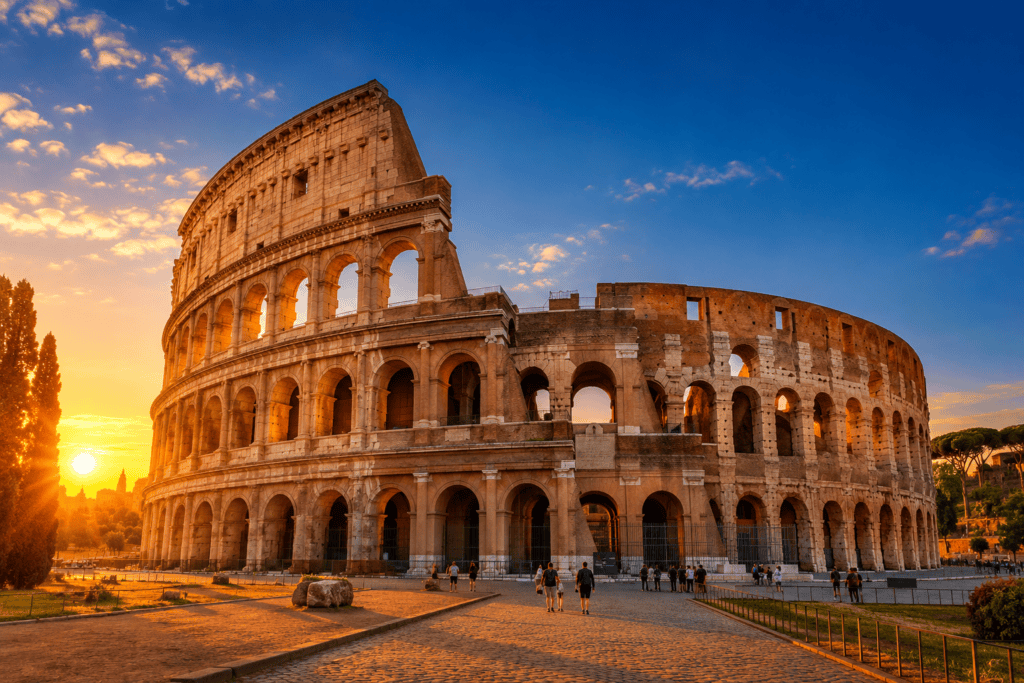
If there is only one thing you can see in Rome, make it this. There aren’t many chances to stand before one of the 7 modern-day wonders of the world. The Colosseum is the most intact ruins I have ever walked through. It is hard to grasp how the Romans could build such an impressive arena. The gigantic structure has survived earthquakes, fires, and centuries of weather.
Will you be entertained? Absolutely, but manage your expectations first. You won’t charge in like Maximus on horseback with a sword raised. Instead, you picture the Gladiators battling below while you take endless photos. In its prime, the tiered seats and galleries roared above the fighting to the death. That raw history is what makes these giant ruins unforgettable, and it still draws the biggest crowds in Italy (Ministry of Culture, 2024).
What can you see inside the Colosseum beyond the first floor and second floor? The real magic hides in the lower area. A Colosseum Underground Tour grants special access to the arena floor and the chambers beneath it. Down there, intricate elevators once lifted animals up to enter the arena. Engineers even flooded the floor into a miniature lake for mock naval battles.
I did the Colosseum on both Rome trips and botched my tickets twice. As a first-timer in 2018, I turned up with no ticket and joined a brutal long line. Standing in line at the ticket booth is the single worst move. The second time I had only basic entry, with no access to the arena, underground, or attic. I left slightly disappointed both times, and those mistakes are easy to avoid.
Getting Your Colosseum Tickets Right
Full experience tickets unlock those bonus areas, but they sell out within minutes of release. Underground and attic slots open 30 days ahead; arena-floor passes drop 7 days before. Book the moment they’re released to grab additional access to the extra areas. For the smoothest visit, buy tickets online instead of queuing, and read our full Colosseum tickets guide before you book.
A booked guided tour is how you escape the Colosseum crowds and actually learn something. Since security tightened around March 2016, waiting times at the entrance have only grown. A tour gets you in far faster than the restless crowds outside. Platforms like Viator run special guided tours into exclusive parts of these ancient world wonders. They were some of the most interesting tours I’ve taken.
Can you visit the catacombs below? Access is limited to special guided tours, and true catacombs actually sit elsewhere in Rome. Here’s my honest confession, though. The Colosseum felt chaotic both visits, almost like a theme park. That’s exactly why I quietly prefer the Forum right next door, where it’s far easier to relax.
The Roman Forum and Palatine Hill: Heart of Ancient Rome
The Roman Forum, or Forum Romanum, was the centre of the ancient Roman Empire. It was a public square ringed by old temples, arches, market halls, and other important buildings. Beside it rises Palatine Hill, where Roman Emperors built their palaces. Your Colosseum ticket covers both, so no separate ticket is needed.
What is the Roman Forum, really? Picture a glorified marketplace that ran the known world. For centuries this was the center of public life across the empire. Walking among these ancient Roman ruins, you feel the weight of one of history’s greatest civilizations. Most structures lie in fragments now, yet their historic grandeur still shows through the rubble.
The archaeological park is dense with Roman excavations and magnificent structures. My favourite highlights of the Roman Forum were the Arch of Titus, the Temple of Antoninus Pius, and the Temple of Saturn. There’s even a small museum by the prison where, tradition says, the Apostle Paul was imprisoned. He reportedly wrote part of the New Testament there, later gathered into the Bible. These Roman sights to visit sit almost shoulder to shoulder.
What can you see at Palatine Hill? The remains of imperial residences and sprawling palaces, high above the ruins. Legend says Romulus built his first hut right on this rise. The surrounding buildings reveal how powerful and technologically advanced the Romans were. From up here, the whole scene finally makes sense.
Is the Roman Forum worth visiting? Completely, and it rewards a slow pace. I spent a quiet 2 hours here and could genuinely relax. It’s far easier to picture Rome in its prime from this hill. Traveling through Europe, from France to Greece, I’d seen Roman remains everywhere in ancient history. None match this site’s scale or historic weight.
Just steps away sit other forums worth a look. Hadrian’s Forum and Trajan’s Forum lie open beside the street. Do you need a ticket for Hadrian’s and Trajan’s Forum? No, you simply walk by and enjoy the impressive remains. They look especially lovely at night, lit golden against the dark.
Stepping Inside the Pantheon
The Pantheon is a near-2,000-year-old temple turned church in Rome’s Centro Storico. It is crowned by the world’s largest unreinforced concrete dome, pierced by a single round hole. Entry now costs €7, and it stands among the most striking buildings to photograph in the city. You simply step inside and look up.
What’s inside the Pantheon rewards the short queue. This ancient temple became a church during medieval times, which helped it survive. Despite that vast history, its giant dome still holds a world record. It is the largest unreinforced concrete dome ever built, spanning 43.3 metres, a record held since 125 AD (Britannica). That is pure architectonic ingenuity.
Look straight up and the architecture does the rest. A round hole at the dome’s peak lets natural sunlight pour across the floor. When it rains, water falls clean through onto the marble below. For me the dome outshone every tomb and relic inside. The engineering alone makes this one of Rome’s most incredible buildings.
The Pantheon also guards some famous tombs. Here lie Vittorio Emanuele II, the first king of Italy, and the painter Raphael, whose work I’d admired in the Vatican Museum. There’s even a tomb for Queen Margherita, the namesake of the first-ever pizza. It’s a small, delicious piece of trivia to carry home.
On my tight budget in 2018, the Pantheon became a free evening hangout. After walking thousands of steps, everyone would cluster in cobbled Piazza della Rotonda. We’d grab cheap wine or a beer from a grocery store to save money. The square works like a gravitational force in the evenings, pulling in people walking dinner off. That post-dinner atmosphere is the beating heart of the touristy Centro Storico.
Pantheon Tickets, Hours and Timing
How much does the Pantheon cost? I paid just 5 euros in 2022; the standard ticket rose to €7 from July 1, 2026. For a richer visit, add an audio guide near €10, an official guided tour around €25.50, or a premium immersive experience closer to €50 through Viator. Is the Pantheon free? Only for under-18s, Rome residents, and worshippers attending Mass.
Pantheon opening hours run daily, roughly 9:00 AM to 7:00 PM, with last entry at 6:30 PM. The best time to visit is first thing, when it’s quietest. To skip the Pantheon line and its enormous lines, book in advance or arrive before it opens for the front of the queue. One note on free days: many of Rome’s state-run sites, though not the Pantheon, are free to enter on the first Sunday of each month.
The Borghese Gallery
The Borghese Gallery is a small but dazzling art museum inside Rome’s Villa Borghese park, holding masterpieces by Caravaggio, Raphael, and Bernini. It is one of the city’s most sought-after sights, with strictly limited entry — only around 360 visitors are admitted per two-hour slot, so tickets must be booked well in advance.
One thing that confuses first-timers is the difference between Villa Borghese and the Borghese Gallery. Villa Borghese is a sprawling 200-acre park, around 80 hectares of lawns and lakes. The Borghese Gallery is just a small building on its eastern edge. The walk there, up Via del Corso and through the gardens, is part of the pleasure.
The collection is tiny and the gallery caps numbers tightly, which is exactly why tickets don’t merely sell out in advance — they vanish almost instantly when released, roughly four to five weeks ahead (Galleria Borghese). This popular museum rewards planners, never chancers. I turned up once without a ticket and never got in; don’t make my mistake.
Getting Borghese Gallery Tickets
So how do you see the Borghese Gallery? Get onto the official ticket site and be ready a month ahead for your chosen date. When do Borghese Gallery tickets go on sale? About four to five weeks before. Do they sell out? Yes, and fast, which is why booking in advance is strongly recommended.
What should you do if tickets are sold out? Don’t surrender. Keep checking daily for cancellations, including last-minute ones the day before or the day of. If none surface, a guided tour through Walks of Italy or Viator is your best backup, bundling skip-the-line entry and an expert guide. Is the Borghese Gallery worth visiting? Completely — if you can snag a slot.
Soaking Up the Foodie Scene in Trastevere
Trastevere is Rome’s beloved old working-class neighbourhood across the Tiber, and the city’s best area for food, wine, and evening buzz. Its name means “beyond the Tiber” in Latin. Expect a maze of narrow streets, charming cafes, and delicious restaurants. For me, it’s the finest place to eat, drink, and people-watch.
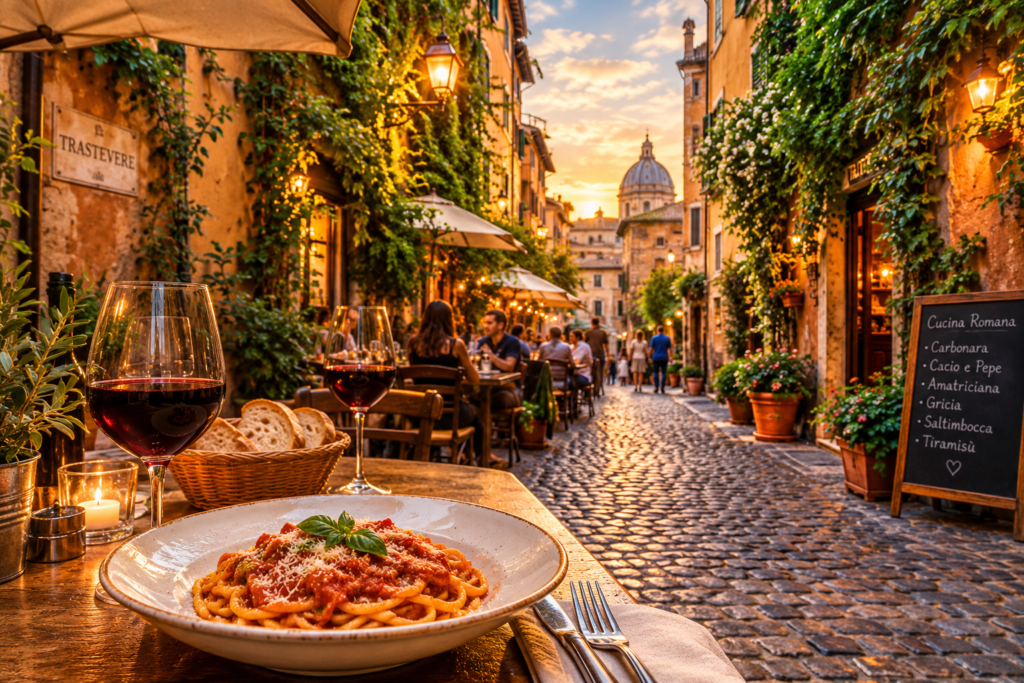
Most of Rome’s top attractions and trendy neighbourhoods are surprisingly walkable and close to each other. The city has cool, attractive, historic quarters like Centro Storico, Monti, Campo Marzio, and Prati. But vibrant Trastevere is my favourite place to relax, unwind, and socialize. It sits on the opposite bank of the Tiber River, just south of Vatican City. A typical Italian neighbourhood, lived-in and loud in the best way.
Trastevere is the 13th rione, or district, of Rome, and its name comes from the Latin trans Tiberim, meaning “beyond the Tiber” (Wikipedia). It was once a warren of fishermen and craftsmen. That heritage survives in its old medieval houses and picturesque cobblestone streets. Some Romans even call this charming neighbourhood the true heart of the city.
Honestly, Trastevere for me is all about the food and atmosphere. The vibe recalls Williamsburg in NYC or St. Germain in Paris. There isn’t much to do except wander, eat, and drink. And that is precisely the point. You come here to get lost, not to chase sights. I can’t even hand you a secret hidden gem, because Trastevere itself is the gem.
On my 2022 trip, this is where I kept drifting after long sightseeing days. I’d cross the Ponte Sisto to enter Trastevere’s lamplit lanes. Within minutes I’d land in a little bar like Mr. Brown with an Aperol Spritz. The evenings here hum with a lively night out energy. Then a gelato for the slow walk back to the Centro Storico.
The Trastevere Food Tour
Trastevere is the most popular spot in Rome for highly rated food tours. Italian cuisine is among the most well-known and tastiest food on earth, refined over millennia. A good Trastevere Food Tour walks you through recognized Italian dishes. Think carbonara as a main dish, fresh meats, cheeses, and creamy gelato. Each tasting usually comes paired with house wine or a sharp Italian espresso.
Is a Rome food tour worth it? For a first visit, absolutely. Respected operators like Devour Tours and Walks of Italy run the best food tours in Trastevere. You can also book a pasta-making class or a sunset wine and food tour. I haven’t done one yet, but it tops my list. Tasting your way around is the richest way to experience a city.
Where to Eat, Drink and Stay
Where to eat and drink in Trastevere? Honestly, skip the map and simply wander. The area overflows with charming cafes, trattorias, and delicious restaurants serving authentic Mamma’s Italian food. Loved local trattorias include Tonnarello, Otello, and Nannarella. For what to eat on a Trastevere food tour or a solo dinner, start with classic Roman plates and a glass of local wine. That is the best neighbourhood in Rome for food, no contest.
Where to stay in Trastevere? For a long weekend of pure eating and drinking with no tourist attractions, I’d book somewhere central like Hotel Santa Maria. Staying in the heart of the foodie scene puts the bars and restaurants on your doorstep. Wondering what to see in Trastevere, or things to do after dark? Is it worth visiting at night? That’s exactly when its narrow lanes come alive.
Soaking Up Rome’s Piazzas
Rome’s piazzas are its open-air living rooms — grand public squares where locals gather, eat gelato, and watch the world drift by. The most beautiful include Piazza Navona, Piazza del Popolo, Piazza di Spagna, and Piazza San Pietro. None are globally famous, yet together they outnumber the squares of any other Italian city.
Here’s something that surprised me about Italy. Rome is the biggest tourist destination, the capital city, and the former heart of the Roman Empire. Yet none of its piazzas are household names. I’d heard of St. Mark’s Square in Venice and the Piazza del Duomo in Florence. But Rome’s own squares? I honestly had no idea what to expect.
Then I arrived and started exploring. It turns out Rome has more piazzas than any other Italian city. They may be less famous, but they’re attractive and genuinely worth seeking out. The eternal city hides a beautiful square around nearly every corner. So which piazzas to see in Rome, and which are the best squares to visit? These are the most famous ones below.
Piazza Navona: Rome’s Baroque Showpiece
Piazza Navona is Rome’s most well-known and most beautiful square. It sits right around the corner from the Pantheon, a perfect place to take a break from the hustle and bustle of downtown Rome. Its elongated shape is no accident. The square traces the exact outline of the Stadium of Domitian, a Roman athletics stadium built by Emperor Domitian around 80 AD that seated roughly 30,000 spectators (Wikipedia).
What is Piazza Navona famous for today? Its fountains, art, and theatrical flair. At the centre stands Bernini’s Fontana dei Quattro Fiumi, known simply as the Fontana dei Fiumi. Its four statues represent the four largest rivers of the then-known continents. The impressive baroque church of Sant’Agnese faces it beneath an ancient obelisk. You can even tour the excavations of the old stadium below.
I’ll confess, I may have eaten a gelato or two here. By day the square hums with street performers, cafés, and terraces. My tour guide swore it was the heart of Roman social life, and he wasn’t wrong. That mix of symbolism and layered history is pure Rome. Is Piazza Navona worth visiting? Without doubt — it’s one of the city’s most remarkable squares and best places to visit.
Piazza del Popolo and Piazza di Spagna
Piazza del Popolo is a stunning, iconic square you shouldn’t miss. This large neo-classical square was reshaped in the 19th century to welcome visitors who entered Rome from the north. Its noteworthy sights include two identical churches, the Porta del Popolo city gate, and a towering Egyptian obelisk. Steps then climb to Pincio Hill for a wonderful view. It’s also the square I crossed to reach Villa Borghese.
Nearby, Piazza di Spagna sits at the foot of the Spanish Steps. Together, Popolo and Spagna are perfect for slowing down. It’s easy to slip into go-go-go mode as a tourist with so much to see. But sitting in a piazza with a gelato is one of the best experiences in Rome. Where to unwind in Rome? These two favourite piazzas, with some pencilled-in downtime.
More Squares Worth a Stroll
A few more squares reward a slow stroll. Piazza San Pietro in Vatican City fills with crowds waiting for the basilica by day, but it looks amazing at night when it’s lit up. Piazza Venezia fronts the Monument to Victor Emmanuel II — a free-to-enter temple and war memorial with a viewing platform. And Campo de’ Fiori is the one to visit for food markets.
Here’s my simple advice after a full day walking around the city. In this eternal city, I’m not sure there are more churches or more piazzas. Just sit down somewhere and sip a strong Italian coffee. Watch people passing by and soak up the bella vita. So which is the best piazza in Rome for people-watching? Honestly, whichever one you happen to be sitting in.
A Visit to Vatican City
Vatican City is the smallest country in the world, a walled enclave tucked inside Rome and the spiritual home of the Catholic faith. Though wrapped entirely by Italy, it is a sovereign state and the residence of the Pope. Its star attractions are St. Peter’s Basilica, the Vatican Museum, and the Sistine Chapel.
One of the most incredible sights to see in Rome technically isn’t in Italy at all. Is Vatican City in Italy? Not quite — it’s an independent supreme state within Rome’s city limits. So what is the smallest country in the world? This walled 44-hectare enclave, home to the Pope and the holy chair of the Church (Britannica).
The Vatican also guards some of the world’s most impressive art and architecture. It is the most important location for Christianity, and St. Peter himself lies buried beneath the basilica. What to see in Vatican City? Far more than one visit allows, since even the Pinacoteca and Vatican gardens could fill a day. Here are the essentials.
St. Peter’s Basilica
Is St. Peter’s Basilica worth visiting? On its own, completely. It is the largest church in the world, crowned by a beautiful dome. That dome is an architectural phenomenon designed by Michelangelo himself. Entrance is free, though you’ll pass a security check first. Just inside, Michelangelo’s world-renowned Pietà waits near the door.
Best time to visit St. Peter’s Basilica? Early morning or the end of the day, when the queues thin out. Weekdays beat weekends, and holidays are always packed. And when is St. Peter’s Basilica closed to visitors? On Wednesday mornings, during the Pope’s papal audience on the square out front.
Climbing the Dome
My personal highlight was the view from atop St. Peter. You climb to the top of Michelangelo’s cupola for a sweeping panorama of Rome. The old €5 ticket now costs around €8 for all 551 steps on foot, or roughly €10 with the lift. The space right at the top is tight, so skip the final stretch if you’re badly claustrophobic.
When is the best time to take photographs at the Vatican? Late in the evening, when the sun sits behind the dome. The low light turns the whole basilica a warm gold. It’s well worth timing your climb for that final golden hour.
The Vatican Museum and Sistine Chapel
After the basilica, you absolutely must visit the Vatican Museum. It’s wise to buy tickets in advance online, roughly €20 plus a small booking fee in 2026. The Vatican gets very crowded, so expect a gigantic crowd around its spectacular collection. Inside hang priceless artworks from Raphael, Caravaggio, and Bernini. Our full guide to visiting the Vatican Museums walks you through booking and timing.
Your museum ticket also covers the Sistine Chapel, one of the most astonishing places on earth. Frescos by Michelangelo, Botticelli, Perugino and other famous painters cover every inch of its ceiling masterpieces. This is where the popes are traditionally elected, the very heart of Christianity. How to visit the Sistine Chapel? Only through the Vatican Museum, saved for the end of the route.
How long to spend at the Vatican Museum? Plan at least half a day for the galleries and the Sistine Chapel, and more if you want the Pinacoteca and gardens. As for how to skip the lines at the Vatican, book a special tour or a timed ticket rather than joining the long lines on the day.
Marvelling at the Trevi Fountain
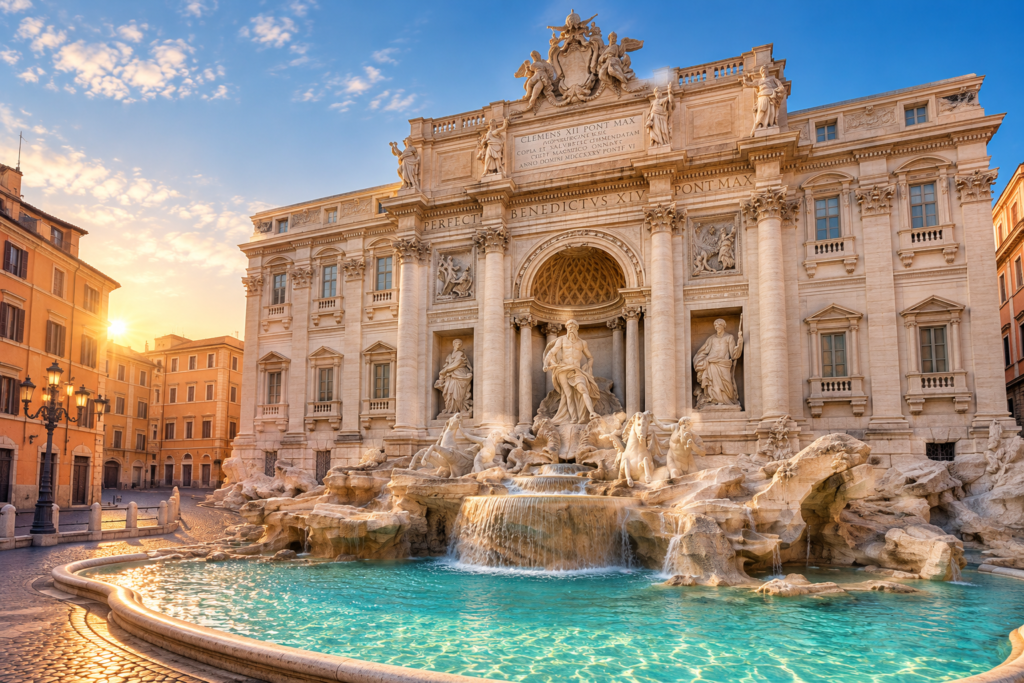
The Trevi Fountain, or Fontana di Trevi, is the most famous fountain in the world and a must-see in Rome. This 18th-century Baroque monument shows the sea god Neptune riding his chariot. It’s free to view from the square in the capital of Italy. But since February 2026, a €2 ticket is needed to reach the lower steps.
What is the Trevi Fountain, exactly? It’s Rome’s grandest water feature, filling the little Piazza di Trevi. Its massive marble statue of Neptune, the god of the sea, looks almost lifelike. The fountain is still supplied by water from the ancient Roman aqueducts. Built in the 1700s, this iconic landmark is a showpiece of Baroque architecture.
Here’s a figure I love. Visitors toss around €3,000 in coins into the basin every single day. That adds up to roughly €1.5 million a year, all donated to the Caritas charity (Wanted in Rome). No wonder it ranks among Rome’s most famous sites.
Throwing a Coin in the Trevi Fountain
Legend says that if you throw a coin into the fountain, you’re assured to return to Rome. So what does throwing a coin in the Trevi Fountain mean? The ritual is precise: toss it with your right hand over your left shoulder. One coin promises a return to Rome, a second brings new romance, and a third seals a marriage. So ladies, count your coins carefully.
I honestly couldn’t believe my eyes the first time. I’d just finished a delicious pizza and a glass of wine, grabbed an ice cream, and wandered over. Then came the crush — hundreds of visitors crammed shoulder-to-shoulder around the three exposed sides. It’s not my scene, so I escaped within a minute, dripping gelato. I’ve been back a dozen times since, by day and at night.
The €2 Fee and the Best Time to Visit
Big change for 2026. Since February, Rome charges €2 for up-close access to the fountain’s lower steps (Frommer’s). You can still see it for free from above in the square. Tickets are required to get closer, roughly between 9:00 AM and 10:00 PM, bought online or on-site. Is the Trevi Fountain free? To look, yes; to stand at the basin and throw a coin, no.
So what’s the best time to visit the Trevi Fountain? Early morning, hands down. Arrive around 8:00 AM, before the fee kicks in, and you’ll beat both the charge and the masses. My favourite is right after sunrise, when I once got a photo of it nearly empty. That’s my simple travel hack to skip the Trevi Fountain fee and avoid the crowds. By mid-day it’s packed with tourists; if you want that bustling atmosphere, come around 8:00 PM.
Is the Trevi Fountain a must-see for first-timers? Yes. It didn’t blow me away, and parts felt like pure hype. But look past the crowd and the Baroque detail suddenly bursts to life. Is it worth visiting at night? Absolutely — lit up, it’s one of Rome’s most beautiful spots. No Rome sightseeing is complete without it, so slot it into a Centro Storico walking loop on an easy first day in Rome.
Climbing the Spanish Steps
The Spanish Steps are Rome’s most famous staircase — 135 travertine steps rising from Piazza di Spagna to the Trinità dei Monti church. Built in the 18th century and funded by a French diplomat, they’re completely free to climb for a sweeping view over Rome. Sitting on them has been banned since 2019.
What are the Spanish Steps? They’re a beautiful Baroque staircase in the heart of Rome, officially the Scalinata di Trinità dei Monti, and some call them the most famous perrons in the world. The 135 steps lead up from Piazza di Spagna, sitting at the foot of the twin-towered French church. From the top of the stairs you get a breathtaking view over Rome’s rooftops, with St. Peter’s Basilica in the distance.
Built between 1723 and 1725, the steps were designed by Italian architects and financed by a Frenchman, the diplomat Étienne Gueffier (Lonely Planet). They’re often called the widest staircase in Europe. A few years ago they were fully renovated in a €1.5 million restoration paid for by Bulgari. At the base sits the distinctive Barcaccia fountain, built by Pietro Bernini.
Why Are They Called the Spanish Steps?
So why are the Spanish Steps called the Spanish Steps? It’s a quirk of history. The staircase was commissioned and financed by the French, and a French church designed by Italian architects crowns the top of the steps. The nickname comes from the Spanish Embassy at the bottom, in Piazza di Spagna. Imagine if they were called the French Steps instead — doesn’t have the same ring.
Visiting, Photos and Shopping
I never imagined that walking up and down a staircase would be such a popular thing to do. But the Spanish Steps are a classic, completely free rite of passage for proper tourists on a first visit to Rome. Honestly, there’s nothing special to actually do there. It’s simply a postcard-perfect scene, which is why thousands of people flock here daily to take photos.
Part of why it’s so busy is the location. The steps sit at the end of Via dei Condotti, the Rodeo Drive of Rome and its trendiest shopping area, close to the northern end of Via del Corso. I spent an hour wandering a maze of piazzas and cobbled alleys full of bougie independent boutiques. That high-end luxury vibe runs through Campo Marzio up to Piazza del Popolo. Reward yourself with a gelato break after shopping.
Here’s the catch — it’s always jam-packed and crowded with tourists. The sheer amount of tourists turns this tourist hotspot into a crush all day. On my last morning in 2022, I marched up at sunrise for a people-free photo. Even then, I waited out a few Instagram and TikTok selfie video shoots. So the best time to photograph the Spanish Steps is early in the morning, before the crowds.
Can you sit on the Spanish Steps? No. Sitting has been banned since 2019 to protect the monument, with fines reaching €400. You can still climb, descend, and soak up the fun atmosphere. In spring and summer, flowers blossom in pots down the staircase, which makes the scene even prettier.
Are the Spanish Steps worth visiting? If you have time, yes — it’s a cool photo spot with a gorgeous view and real buzz. Is walking up the Spanish Steps worth it on its own? Not make-or-break, honestly. But as one of the easy things to do near the surrounding area, it slots neatly into any list of things to do in Rome. Go early and hope everyone plays nicely.
Exploring Castel Sant’Angelo
Castel Sant’Angelo is a towering cylindrical fortress on the Tiber, originally built as the Mausoleum of Hadrian and completed around 139 AD. Later a papal stronghold, it’s now a national museum with one of Rome’s finest rooftop views. It stands beside the Ponte Sant’Angelo bridge, a short walk from the Vatican.
Guarding the ancient Roman Ponte Sant’Angelo bridge and the Tiber River, Castel Sant’Angelo is a can’t-miss attraction. What is Castel Sant’Angelo, also written Castello del Angelo? This 2nd-century ancient mausoleum was originally built for Emperor Hadrian and his family. In the 1400s it was repurposed as a fortress and folded into Rome’s defences. Across the centuries, the building served many different purposes.
The Legend Behind the Name
Why is it called Castel Sant’Angelo, the Castle of the Holy Angel? It’s named for a vision. In 590 AD, during a deadly plague, Pope Gregory the Great saw the archangel Michael standing over the fortress, sheathing his sword as a sign the plague was ending (Lonely Planet). A bronze angel still crowns the roof today, which is exactly why it’s named for the angels.
Castel Sant’Angelo wore many hats over the years. Originally a tomb, it became a mighty keep. Several popes stayed in the castle during times of war, using it as a shelter from danger. It’s even linked to the Vatican by a secret tunnel, the Passetto di Borgo. Is Castel Sant’Angelo connected to the Vatican? Yes — popes once fled along that walled passage to safety.
What to See and Ticket Tips
What is Castel Sant’Angelo used for today? It’s an enchanting national museum, layered across seven floors. Inside you’ll find frescoed papal apartments, old prison cells, and a collection rich in Rome’s military history. Is there a museum in Castel Sant’Angelo? Very much so — a lovely museum of weapons, art, and centuries of tangled stories.
The real highlight is the view from above. Climb to the rooftop terrace for a unique angle on St. Peter’s Basilica and the whole city beyond. These rank among the best views of St. Peter’s Basilica anywhere in Rome. Down at ground level, the cobblestones out front draw a steady crowd, including girls taking pictures for the perfect frame.
How much are Castel Sant’Angelo tickets? Around €18 per adult, the same as the Colosseum and Roman Forum. Honestly, I was on the fence, since the value for money didn’t quite stack up for me. Is Castel Sant’Angelo a must-see on a first visit? Not in my view. But after two trips doing everything else, it’s something different I’d happily try next time.
Gazing Up at the Victor Emmanuel II Monument (Altar of the Fatherland)
The Victor Emmanuel II National Monument, or Altar of the Fatherland, is a vast white-marble memorial on Piazza Venezia, dedicated to the first king of unified Italy. Built between 1885 and 1935, it also guards Italy’s Tomb of the Unknown Soldier. From its rooftop, it serves up some of the best views of Rome.
What is the Victor Emmanuel II National Monument? It’s an enormous memorial honouring Victor Emmanuel II, the first king of unified Italy. Walking from the center of Rome toward the Colosseum, there’s simply no missing this gigantic monument. It sits less than a kilometer away from the Colosseum and Roman Forum. Built across fifty years and inaugurated in 1911, it rises 70 metres in gleaming white marble (Wikipedia).
The monument is also home to Italy’s Tomb of the Unknown Soldier, interred here in 1921. An eternal flame burns beside it, honouring the nation’s fallen soldiers. Two guards keep watch over it day and night. It’s a solemn heart tucked inside an otherwise grand, showy structure.
Why Italians Call It “the Wedding Cake”
So why is it called the wedding cake? Blame its frothy, tiered white layers. Many Italians find it new and unsightly, and some nickname it “the typewriter” instead. A taxi driver once described it as a gaudy wedding cake topper, out of place in the ancient city of Rome. Beside all those ruins, this neoclassical giant does feel a touch out of step.
Personally, though, I find it genuinely impressive. If this monument stood in Washington D.C., it would rank among the proudest landmarks in the capital city. It’s a real testament to just how many amazing things there are to see in Rome. Here, oddly, it’s usually mentioned only as an afterthought.
The Best Views in Rome
Here’s the real reason to go up. A glass lift carries you to the rooftop terrace for sweeping 360-degree panoramas. These are some of the best views of Rome, stretching across the alluring, beautiful city and its rooftops. Wondering what to see near the Colosseum, or is the Altar of the Fatherland worth visiting? Put it near the top of things to see in Rome — love it or loathe it, this landmark is definitely worth a visit.
Inside the Vatican Museums
The Vatican Museums hold the art the popes gathered over five centuries — roughly 70,000 works spread across 54 richly decorated rooms. The one-way route winds past Roman sculpture, countless paintings, and Raphael’s frescoes, ending in the famous Sistine Chapel. It’s one of the world’s greatest collections, and one of Rome’s busiest attractions.
What to see in the Vatican Museums? Over the centuries, the popes amassed an enormous art collection, from Roman objects and religious relics to countless paintings. You move through room after room packed with the art treasures of the Catholic church. The complex holds around 70,000 works and drew 6.8 million visitors in 2024, second only to the Louvre (Wikipedia).
How many rooms are in the Vatican Museum? The visitor route threads through 54 richly decorated rooms, one flowing straight into the next. Each holds its own treasures, from ancient marbles to Renaissance masterpieces. It’s a huge amount to absorb, so pace yourself and don’t try to see every single thing.
The Sistine Chapel
For most visitors, the highlight is the famous Sistine Chapel saved for the very end. What is the Sistine Chapel? It’s a chapel adorned with lovely frescos by Michelangelo, painted between 1508 and 1512. It’s also where the conclave gathers whenever a new pope is elected. No photos are allowed inside this sacred, hushed space.
Visit It Properly, or Not at All
Why are the Vatican Museum lines so long? Simple — it draws so many visitors that this attraction has by far the longest lines in Rome. When I visited independently at lunch time in July 2018, it was far too busy. Honestly, I came away underwhelmed, frustrated, and feeling I’d wasted my time.
I remedied those negative memories on my second try. In May 2022, I went as it opened with a guided tour, and loved it. So should you do a guided tour of the Vatican? Yes, if you want to skip the worst of it. How do you avoid the crowds at the Vatican Museum? Go right at opening, ideally with a guide. I’m not saying skip the Vatican — just do it properly, or you’ll end up with a negative experience.
Stepping Into St. Peter’s Basilica
St. Peter’s Basilica, or Basilica di San Pietro in Vaticano, is the largest church in the world and the spiritual heart of the Catholic Church. Built over the grave of Saint Peter in Vatican City, beside St Peter’s Square, it brims with masterpieces by Michelangelo and Bernini. Entry is free, so plan your visit to beat the lines.
What are the best things to do in Vatican City? Start right here. St. Peter’s Basilica is the spiritual centre of the Catholic Church and tied to the residence of the pope. This enormous basilica stands in the independent state of Vatican City, right beside St Peter’s Square. It was raised on what’s believed to be the grave of Saint Peter himself.
The Masterpieces Inside
What is inside St. Peter’s Basilica? Breathtaking masterpieces. Don’t miss Bernini’s baldachin, the soaring 29-metre bronze canopy over the papal altar (Wikipedia). Beside it waits La Pieta by Michelangelo, carved when he was just 24 and now shielded behind glass. In the largest church on earth, nearly every corner holds some treasure.
Below the main floor lie the Vatican Grottoes, a crypt and resting place for dozens of popes across the centuries. Walking quietly past the papal tombs is a moving contrast to the grandeur overhead. The crypts are free to enter, through a separate door at the side. Is St. Peter’s Basilica worth visiting? Without a shadow of doubt.
Now a word of warning. Plan your visit to St. Peter’s well ahead, or you’ll be standing in line for a long time. How do you avoid the lines at St. Peter’s Basilica? Arrive early, right as it opens in the morning. Entry costs nothing, but everyone still passes through a security check first.
The Scavi Tour: Beneath the Basilica
If you take just one tour in Rome, make it the Scavi Tour. What is the Scavi Tour? It leads below the basilica into the Vatican Necropolis, a hushed maze of preserved ancient streets dating to the 1st century A.D. This is where Saint Peter is believed to be buried. Where is St. Peter buried? Right here, deep beneath the high altar.
Is the Scavi Tour worth it? For history lovers, absolutely — it’s a rare chance to step back in history. But how do you book the Scavi Tour? That’s the catch. Tickets book out months in advance through the Vatican’s Excavations Office, so reserve early. Lock it in the moment your Rome dates are set.
The Basilica di Santa Maria Maggiore
The Basilica di Santa Maria Maggiore is the largest Marian church in Rome and one of its four papal basilicas. Founded in AD 432 on the Esquiline hill, it’s celebrated for shimmering 5th-century mosaics, a gilded coffered ceiling, and a relic said to come from the crib of Jesus. Best of all, it’s free to enter.
What is Santa Maria Maggiore? It’s the grandest church in Rome dedicated to Mary, officially the Basilica Papale di Santa Maria Maggiore. It was founded in AD 432 under Pope Sixtus III, the year after the Church declared Mary the Mother of God (Wikipedia). As one of the four papal churches, it has crowned the Esquiline hill ever since.
The Mosaics, Ceiling and Holy Crib
What to see inside Santa Maria Maggiore? Start by looking up. The nave and triumphal arch glow with authentic early Christian mosaics, some barely touched since the 5th century. Above them stretches a gilded coffered wooden ceiling, said to be covered in the first gold brought back from the Americas. It turns the whole interior molten and golden.
Why is Santa Maria Maggiore famous beyond its art? One precious relic. Beneath the altar rests the Holy Crib — five boards of sycamore wood believed to be from the manger, the crib of Jesus. They sit in a crystal reliquary shaped like a cradle. For centuries the church was even nicknamed “Saint Mary of the Crib.”
Pope Francis’s Resting Place
There’s now a profound new reason to visit. In April 2025, Pope Francis was buried here — the first pope laid to rest outside the Vatican in over a century (Gulf News). The last before him was Clement IX, back in 1669. Seven other popes, along with the sculptor Bernini, also lie within these walls.
Is Santa Maria Maggiore worth visiting? Without question, and entry costs nothing. Unlike the ticketed big-hitters, this papal basilica rewards anyone who simply steps inside. It sits a short walk from Termini station, so it folds easily into a day in Italy’s capital. Few churches in Rome hold this much history in one room.
Standing at the Circus Maximus
The Circus Maximus was ancient Rome’s largest chariot-racing stadium, a vast track in the valley below the Palatine Hill. It once held somewhere between 150,000 and 250,000 Romans roaring at chariot races. Little of its structure survives today, but it’s now a free public park where you can still feel its enormous scale.
What is Circus Maximus? It was the grandest horse race arena the ancient world ever built. What was Circus Maximus used for? Mostly chariot races, the most popular spectator sport in Rome for nearly a thousand years. The track ran about 621 metres long, making it far bigger than the nearby Colosseum (World History Encyclopedia).
How many people did Circus Maximus hold? Estimates range from 150,000 to 250,000 spectators, packed onto its steep banked sides. Picture the famous chariot race from the 1959 movie Ben Hur and you’re close. This gigantic stadium roared as Romans backed their rival teams, the Reds, Whites, Blues, and Greens.
What’s Left to See Today
What is there to see at Circus Maximus now? Honestly, not much structure, since it’s not in good repair and little is left of its ancient glory. Centuries of flooding buried the original track under silt. Even so, it’s become an enormous open public park, and its former size is still obvious the moment you arrive. It’s worth seeing for the sheer scale alone.
Is Circus Maximus worth visiting? For a quick stop, absolutely. It sits right below the Palatine Hill, so it pairs neatly with the Colosseum and Roman Forum next door. It’s free, open, and you can simply walk its full length. Few places in Rome let you stand where a quarter of a million Romans once roared.
Exploring the Baths of Caracalla
The Baths of Caracalla, or Terme di Caracalla, are the vast ruins of an ancient Roman bath complex in southern Rome. Built between AD 212 and 216 under Emperor Caracalla, they once welcomed around 1,600 bathers at a time. Today the towering ruins double as a spectacular open-air opera venue, and they’re usually wonderfully uncrowded.
What are the Baths of Caracalla? They’re the remains of an immense bathhouse from the 3rd century CE. Who built the Baths of Caracalla? Emperor Caracalla, who inaugurated them in AD 216. At the time they were the second-largest baths in Rome, behind only the Baths of Diocletian (Wikipedia).
How big were the Baths of Caracalla? Truly huge. The complex sprawled across more than 25 acres, with brick walls still rising some 30 metres high. It had a capacity of roughly 1,600 bathers at once, and up to 8,000 across a single day. Beyond the baths themselves sat gyms, libraries, gardens, and shops — a full leisure city.
Centuries of earthquakes and the plundering of building materials stripped away the marble. So what is there to see at the Baths of Caracalla today? Soaring arches, scraps of mosaic floor, and the sheer archaeological digs that reveal its scale. Excavations even uncovered an older Roman house buried beneath. It still feels like a genuine ancient ruin, not a theme park ride.
Opera Under the Stars
Here’s the twist that sets this site apart. Each summer, the ruins become the stage for Rome’s open-air opera and ballet season. At these Caracalla Baths you can also don 4D goggles for a VR experience, watching digital recreations rise over the bare walls. Together they give you a vivid impression of its size and vanished grandeur.
Is the Baths of Caracalla worth visiting? Honestly, yes — and it’s often blissfully calm. On most days barely anyone is there, so the ruins feel almost private. It sits a short walk from the Circus Maximus and the Colosseum, so it’s easy to fold in. For scale and quiet, it’s well worth it.
Walking the Appian Way (Via Appia)
The Appian Way, or Via Appia Antica, is one of the oldest and most important Roman roads, built in 312 BC. Nicknamed the “queen of roads,” it runs south from Rome past ancient tombs and catacombs. Today it’s a peaceful archaeological park, best explored on foot or by bike, far from the city crowds.
What is the Appian Way? The oldest of Rome’s great consular roads, often called the world’s first highway. It was built by the Romans in 312 BC under the censor Appius Claudius Caecus, one of the most important roads from Roman times. In July 2024, it became Italy’s 60th UNESCO World Heritage Site (Turismo Roma).
The Roman Appian Way was first laid for moving military troops quickly, and later became vital for trade. Paved with large cobbles and lined with cypresses, it stretched from Rome deep into the south. Because burials were banned inside the city walls, its edges filled with grand funerary monuments. That lasting importance is exactly why it earned the title queen of roads.
The Catacombs
What are the catacombs in Rome? They’re vast underground Christian burial networks, and the most famous of them line the Via Appia. Beneath your feet runs a maze of tunnels hundreds of kilometres long. The Catacombs of San Callisto are the largest, the resting place of 16 early popes. Just beyond sit the Catacombs of San Sebastian.
How to Visit
How to visit the Appian Way? Start at the Porta San Sebastiano gate, just south of the Colosseum. And the best way to see the Appian Way? Honestly, a guided bike tour — the quiet, car-light road is practically made for cycling. You can also join a guided tour that bundles in the nearby Aqueducts and the catacombs, and takes in the road’s tombs and tourist attractions.
What to see on the Appian Way beyond that? Ancient tombs, crumbling villa ruins, aqueduct arches, and the catacombs below. It feels wonderfully off the beaten path, miles from the central crush. One tip: aim for near closing time at the catacombs and you’ll often have them almost to yourself. It’s one of Rome’s most atmospheric corners.
Inside the Capitoline Museums
The Capitoline Museums, or Musei Capitolini, are widely called the world’s oldest public museums, their collection founded in 1471. They crown Michelangelo’s Piazza del Campidoglio atop the Capitoline Hill, packed with masterpiece sculptures and paintings. The headline icons: the bronze She-Wolf, the Dying Gaul, and the original Marcus Aurelius.
What are the Capitoline Museums? A pair of Renaissance palaces holding one of Rome’s greatest collections of classical sculpture and art. The collection dates to 1471, when Pope Sixtus IV handed ancient bronzes to the people of Rome. That makes them, by most accounts, the oldest public museums on earth.
Where are the Capitoline Museums? High on the Capitoline Hill, the ancient Capitol, reached by Michelangelo’s gently stepped Cordonata ramp. The two palaces frame his beautifully designed Piazza del Campidoglio. An underground passage links them and opens onto what many call the finest Roman Forum view in the city.
The Must-See Masterpieces
What to see at the Capitoline Museums? Head straight for the icons. The bronze Capitoline She-Wolf, nursing Romulus and Remus, is Rome’s own emblem. Then comes the haunting Dying Gaul, the graceful Capitoline Venus, and the original Marcus Aurelius on horseback. Two Caravaggios hang quietly in the picture gallery upstairs.
Tickets and Why It’s Worth It
How much are Capitoline Museums tickets? Around €15 in 2026, a little more when a temporary exhibition is running. That entrance fee is roughly half the Vatican’s, yet most tourists walk straight past. It rarely sells out, so you can usually just turn up and buy at the door.
Is the Capitoline Museums worth visiting? If you have a deep interest in art, absolutely. It’s a far quieter, less intense museum than the Vatican, and genuinely one of the better museums in Rome. But if you’re already fighting museum burnout, skip it with a clear conscience. Two or three sites is plenty in this dense city.
Sunset at the Giardino degli Aranci (Garden of Oranges)
The Giardino degli Aranci, or Garden of Oranges, is a free public park on the Aventine Hill, famous for its sweeping terrace view over Rome. From the belvedere you can see the Tiber, Trastevere, and St. Peter’s dome. It’s one of the city’s finest sunset spots, and just minutes from the secret Aventine Keyhole.
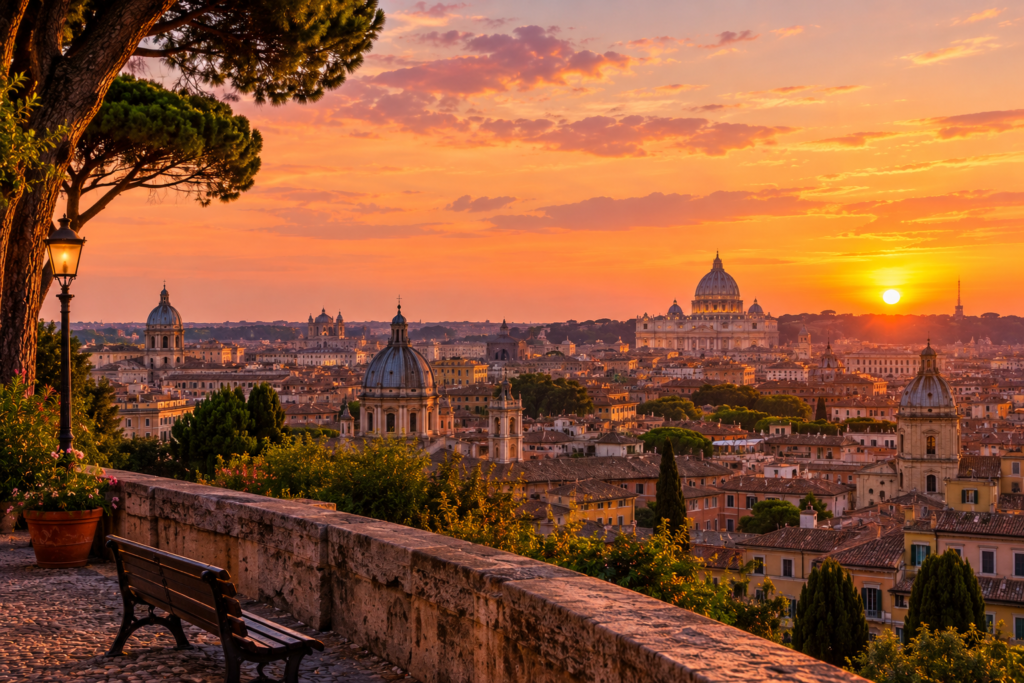
What is the Garden of Oranges? Officially Parco Savello, it’s a quiet orange tree garden on the Aventine Hill, sitting beside the Basilica of Santa Sabina. Rome is a city of many hills, and climbing this one truly pays off. At the far end, a terrace known as the Terrazza Aventino opens onto magnificent views.
From this Aventine Terrace you gaze out over the inner city — the meandering Tiber, Trastevere’s rooftops, and St. Peter’s dome. It rivals the famous Gianicolo and Pincio viewpoints, yet stays wonderfully peaceful. In the evening, climb up for a beautiful sunset. Bring some drinks and a little street food, and you’ve got the perfect moment.
The Aventine Keyhole
Where is the Aventine Keyhole? Just a three-minute walk away, at the Priory of the Knights of Malta on Piazza dei Cavalieri di Malta. Peek through a door — the famous keyhole — and you’ll see St. Peter’s dome perfectly framed by a hedge-lined path. The illusion was no accident: the artist Piranesi aligned the whole garden to frame it, back in 1765.
Nearby on the Aventine
The whole hill makes a lovely slow loop. On the way up you’ll pass the Roseto Comunale, Rome’s public rose garden, which blooms each spring. If you’d rather chase sunset elsewhere, you can instead climb the Pincio terrace above Piazza del Popolo. Both are free, uncrowded, and the gardens themselves are charming in their own right.
Is the Garden of Oranges worth visiting? For free, without a doubt. These rank among the best views in Rome and its loveliest, least-crowded viewpoints. Trade the big-sight crowds for an hour and come here at golden hour instead. Few corners of the city feel this calm.
Descending Into the Basilica di San Clemente
The Basilica di San Clemente is Rome’s famous “lasagna church” — three levels of history stacked one atop another. A 12th-century basilica sits over a 4th-century early Christian church, which sits over 1st-century Roman buildings and a pagan Mithraic temple. You descend through nearly 2,000 years in a single visit.
What is San Clemente, and why is it famous? At street level, this church dedicated to Pope Clement I looks modest, not impressive at first glance. All the magic lies underground. Over the centuries, builders simply stacked church upon church into multiple levels, leaving layers of history you can physically walk down through.
The Three Levels of History
How many levels is San Clemente? Three. The upper 12th-century basilica dazzles with golden medieval mosaics — the “Triumph of the Cross” glowing in the apse (Italia.it). Descend and you reach a 4th-century early Christian church, once a secret place of worship, now lined with faded frescoes. Go deeper still to the 1st-century Roman building and its ancient foundations.
The strangest sight waits at the very bottom. Hidden among the Roman foundations is a pagan Mithraic temple, a shrine to the god Mithras. Nearby, an ancient underground stream still rushes audibly beneath the floor. It’s one of Rome’s eeriest and most atmospheric spaces, far from any crowd.
What to see at San Clemente, and is it worth visiting? Absolutely. It’s a few minutes’ walk from the Colosseum, discovered by Irish Dominican monks in the 1850s and still being excavated today. The upper church is free; the lower excavations cost about €10, tracing the whole history of the church downward. Few places pack this much into one descent.
Nero’s Golden House: The Domus Aurea
The Domus Aurea, or Golden House, was Emperor Nero’s vast palace, built after Rome’s Great Fire of AD 64. Once a sprawling complex of gilded halls and gardens, it was buried and forgotten for centuries. Today you explore its underground ruins and frescoes on a guided tour, with a VR headset bringing the whole thing back to life.
What is the Domus Aurea? It’s the buried remains of ancient Rome’s most extravagant palace. Who built the Domus Aurea? The emperor Nero, who seized the land after the Great Fire of 64 AD to raise an enormous palace across three hills. It was so lavish it was designed to glitter with gold, marble, and waterfalls.
After Nero died, his hated palace was stripped, filled with earth, and built over. The Colosseum rose on the site of his private lake, and the Baths of Trajan were laid directly on top of the Golden House itself. For over a thousand years it lay underground, lost and forgotten, until Renaissance artists like Raphael dropped in on ropes — inspiring the “grotesque” decorative style named after its grotto-like rooms.
What to See Today
Walk the excavations now and you move through vast, echoing halls deep below the modern city. Faint ancient frescoes still cling to the walls, the very ones those Renaissance masters once copied. It’s a cool, dim, atmospheric space — a genuine lesser-known attraction and one of Rome’s finest hidden gems.
How to Visit (and the VR Tour)
How to visit the Domus Aurea? Only on a small-group guided tour, booked ahead, since reservation is necessary. When is the Domus Aurea open? Weekends only, because restoration work fills the weekdays. It reopened to visitors in 2014, and on weekend tours you don a VR headset for a dazzling 3D reconstruction, seeing exactly what it looked like, gilded and gleaming, 2,000 years ago.
Is the Domus Aurea worth visiting? For history lovers, absolutely. It sits on the Colle Oppio hill, directly opposite the Colosseum, so it pairs perfectly with a visit there. Few experiences in Rome make the ancient world feel this vivid. Book early, though, because the weekend slots go fast.
The Bone Chapels of the Capuchin Crypt
The Capuchin Crypt is a series of small chapels beneath the church of Santa Maria della Concezione dei Cappuccini in Rome, decorated entirely with the bones of around 3,700 Capuchin friars. Far from a horror show, it’s a solemn memento mori — a quiet, deeply moving meditation on mortality, cared for within the Catholic tradition.
What is the Capuchin Crypt? It’s one of Rome’s most extraordinary and unsettling sights. Where is the Capuchin Crypt? Beneath the church of Santa Maria della Concezione on Via Veneto, near Piazza Barberini and the Barberini metro. Five of its six small crypts are decorated, floor to ceiling, with human bones (Visitor guide).
The Bone Chapels
How many bones are in the Capuchin Crypt? The remains of roughly 3,700 Capuchin friars, who died between 1528 and 1870. The brothers arranged them as works of art — walls and arches of skulls, and even chandeliers of bone hanging overhead. In one chapel, robed skeletons still stand among the ossuary. It is at once macabre and, somehow, strangely beautiful.
The Famous Plaque
What does the Capuchin Crypt plaque say? Near the exit, a plaque delivers its message plainly: “What you are now, we once were; what we are now, you shall be.” It’s the ultimate memento mori — a sincere reminder of death and of mortality itself. The friars meant it not to frighten, but to make every visitor pause and reflect.
Before the crypt, you pass through a small museum on the Capuchin Brothers and their order. Is the Capuchin Crypt worth visiting? If you’re drawn to the solemn and the quietly strange, yes. It’s a bizarre place, but a profoundly respectful one. No photographs are allowed, so you simply stand, look, and remember.
Testing the Bocca della Verità (Mouth of Truth)
The Bocca della Verità, or Mouth of Truth, is an ancient Roman marble mask set in the portico of the church of Santa Maria in Cosmedin in Rome. Legend says it bites off the hand of any liar who places their hand in its mouth. It’s free to see, wildly famous, and makes a quick, fun photo stop.
What is the Mouth of Truth? It’s a huge carved marble disc, about 1.75 metres across and weighing some 1,300 kg. The ancient bearded face probably depicts Oceanus, the sea god, a kind of river god. No one is quite sure of its original use — most likely an ancient drain or man-hole cover from a nearby Roman temple.
The Legend (and the Movie)
What is the legend of the Mouth of Truth? It’s an ancient lie detector. Put your hand in its mouth and tell a lie, so the story goes, and the stone jaws snap shut and bite off the hand. What movie featured the Mouth of Truth? The 1953 classic Roman Holiday, in which Gregory Peck pretends his hand has been bitten off to startle Audrey Hepburn — the scene that made it world-famous.
Visiting the Mouth of Truth
Where is the Bocca della Verità? In the portico of Santa Maria in Cosmedin, at the foot of the Aventine Hill. It’s free to look, with a small donation to pose, so bring a little cash. Expect a queue of tourists shuffling forward for selfies, each daring to slip a hand into the mouth.
Is the Mouth of Truth worth visiting? For the detour, yes — it’s a charming curiosity, though honestly a five-minute stop. The handy part: it sits right below the Giardino degli Aranci, so you’ll walk right past it on your way up the hill. Snap your photo, then carry on to the view.
The Archbasilica of San Giovanni in Laterano (St John Lateran)
San Giovanni in Laterano, or St John Lateran, is officially the most important church in Rome — not St Peter’s. It is the cathedral of Rome and the Pope’s own seat as Bishop of Rome. Founded in AD 324, it’s the oldest of the four papal basilicas, yet it draws surprisingly few tourists.
What is San Giovanni in Laterano? It’s the archbasilica that technically outranks every church in Catholicism. Is St John Lateran the most important church in Rome? Yes — as the cathedral of the Roman diocese and the official seat of the Pope, it sits above even St Peter’s. Founded in 324, it’s the oldest basilica in the Western world, inscribed as the mother of all churches (Wikipedia).
The Façade and Interior
What to see at San Giovanni in Laterano? Start outside. The distinctive façade, designed by Alessandro Galilei in 1735, is crowned with fifteen colossal giant statues of Christ and the saints. The church has been modified over the centuries into a grand baroque interior. Step inside and it’s vast, gilded, and completely free to enter.
The Scala Sancta (Holy Stairs)
Across the piazza waits the Scala Sancta, the Holy Stairs. These 28 marble steps are said to be the very ones Jesus climbed in Jerusalem during his Passion. To this day, pilgrims ascend them slowly on their knees, in prayer. It’s one of Rome’s most quietly moving religious sights.
Where is St John Lateran? Southeast of the centre, a short metro ride or 15-minute walk from the Colosseum. Is San Giovanni in Laterano worth visiting? For its history and sheer rank among Italy’s churches, absolutely. Because it sits away from the tourist core, you’ll often have this mighty basilica almost to yourself.
Trajan’s Markets: Ancient Rome’s “Shopping Mall”
Trajan’s Markets, or Mercati di Traiano, is a sprawling multi-level Roman complex beside Trajan’s Forum, often called the world’s first shopping mall. Built around AD 100–110 under Emperor Trajan, this five-storey, semi-circular ruin now houses the Museum of the Imperial Forums. Nearby soars the famous Trajan’s Column.
What are Trajan’s Markets? A vast, well-preserved sweep of brick ruins overlooking the forum. Who built Trajan’s Markets? Emperor Trajan commissioned them around AD 100–110, designed by his favourite architect, Apollodorus of Damascus. Despite the “oldest shopping mall” nickname, historians now believe much of it was actually administrative offices rather than shops.
So was it really a market? Partly. This five-storey, semi-circular complex did hold some shops and an ancient marketplace, but also offices, great halls, and warehouses stacked into the hillside. In truth it was a mixed-use civic hub, grand and highly functional at once.
Trajan’s Column
What is Trajan’s Column? A towering carved column standing beside the forum, raised around AD 113. Its surface spirals with a detailed relief frieze commemorating Emperor Trajan’s victories in the Dacian Wars. Around 30 metres tall, this Trajan’s Column is one of ancient Rome’s finest monuments, and free to admire from the street.
The Museum of the Imperial Forums
What to see at Trajan’s Markets today? Beyond the ruins, part of the complex houses the excellent Museum of the Imperial Forums. It gathers artefacts from all the Imperial Forums, Rome’s chain of grand public squares built by the emperors. Is Trajan’s Markets worth visiting? For ancient-Rome fans, yes — it sits opposite the Colosseum, making it an easy, uncrowded add-on to a forum day.
The Ara Pacis: Augustus’s Altar of Peace
The Ara Pacis, or Altar of Peace, is a beautifully carved marble altar in Rome built to honour Emperor Augustus and the Pax Romana. Commissioned by the Roman Senate in 13 BC and dedicated in 9 BC, it’s one of the finest works of Roman art, now displayed in a sleek glass museum right beside the Tiber.
What is the Ara Pacis? Officially the Ara Pacis Augustae, it’s an ancient altar dedicated to peace. Who built the Ara Pacis? The Roman Senate commissioned it in 13 BC to mark the return of the emperor Augustus from Gaul and Spain, consecrating it in 9 BC (Britannica). For centuries it stood out on the Campus Martius.
What the Carvings Represent
What does the Ara Pacis represent? Peace and prosperity under Augustus — the Pax Romana itself. Its intricately detailed marble enclosure is covered in carved reliefs: a solemn religious procession of Augustus, his family, and priests, set alongside mythological scenes and flowing floral friezes. These rank among the greatest surviving examples of Roman art.
The Richard Meier Museum
Where is the Ara Pacis today? Beside the Tiber, on the Lungotevere near the Mausoleum of Augustus. After centuries buried under river silt, it was painstakingly restored and reassembled, then housed in a striking modern museum. The luminous glass pavilion was designed by American architect Richard Meier and opened in 2006 — the first new building in Rome’s historic centre in over fifty years.
Is the Ara Pacis worth visiting? For lovers of Roman history and art, yes. The cool, light-filled hall lets you study every carving up close, well away from the crowds. It sits a short walk from the Spanish Steps and Piazza del Popolo, so it slots neatly into a central stroll along the Tiber.
The View from the Janiculum Hill (Gianicolo)
The Janiculum Hill, or Gianicolo, is Rome’s finest panoramic viewpoint — a terrace above Trastevere with a sweeping rooftop panorama of the city and St. Peter’s dome. It’s free, uncrowded, and one of the best sunset spots in Rome. As a bonus, a cannon is fired from the hill every single day at noon.
What is the Janiculum Hill? It’s a tall ridge on the west bank of the Tiber, rising just above Trastevere. Where is the Gianicolo? Right there — though, curiously, it isn’t one of Rome’s famous seven hills, since it sits west of the river (Wikipedia). Even so, this Colle del Gianicolo serves up the widest, most magnificent view in the city.
The Panorama
The main terrace sits at Piazzale Garibaldi, crowned by a grand equestrian statue of Giuseppe Garibaldi from 1895. From the belvedere you look out over domes, bell towers, and St. Peter’s dome glowing in the distance toward the Vatican. These are some of the best views in Rome, and the panoramic sweep is simply unbeatable.
The Noon Cannon and the Fountain
Two quirks make the climb extra worthwhile. Every day at exactly noon, a cannon is fired from the hilltop, a tradition here since 1904. And on the walk up from Trastevere, you pass the Fontana dell’Acqua Paola, a magnificent baroque fountain locals fondly call “Il Fontanone.” Try to time your visit for the noon cannon if you can.
How to get to the Janiculum? Walk up from Trastevere in about 15 minutes, or hop on a bus to the top. Best of all, come at golden hour. As a free, peaceful sunset spot, the Gianicolo beats every ticketed terrace in the city hands down. Few places let you watch Rome turn to gold in such calm.
Eating Your Way Through Rome
Rome’s food is its own reason to visit. The city is famous for four classic pastas — carbonara, cacio e pepe, amatriciana, and gricia — plus thin, crispy Roman pizza, crunchy supplì, and silky gelato. What to eat in Rome? Start with those, then work your way through artichokes, antipasti, and the sweet dolci.
What’s the one thing every visitor does in Rome? Hunt for amazing food. And honestly, the hunt never lasts long. This is a city built on simple, hearty cooking — cucina povera, “poor man’s food,” at its very best. From pasta to gelato, sampling Italian food here feels as essential as any monument. The spoils are plenty and cheap.
The Pasta: Rome’s Four Classics
What food is Rome famous for? Above all, pasta. The city’s four timeless classics are carbonara, cacio e pepe, amatriciana, and gricia (Rome’s traditional foods). Each leans on just a handful of ingredients — pecorino, guanciale, pepper, egg. Order a bowl of homemade pasta and you’ll taste the best food in Rome. Beyond the classics, try gnocchi on a Thursday, a Roman tradition, or a creamy northern risotto.
Pizza, Supplì and Street Food
Now for the street food. Roman pizza is thin and crispy, often sold al taglio by the slice — quite different from the puffy, authentic Neapolitan-style pizza born down in Naples. Grab a supplì too, a fried rice ball oozing melted mozzarella. And don’t skip artichokes, served braised carciofi alla romana or deep-fried alla giudia. To begin, antipasti platters of cured meats and fish set the table.
Gelato, Dolci and Drinks
For dessert, turn to the dolci. Milky gelato is the obvious joy, but where to eat gelato in Rome really matters. Skip the giant neon touristy gelato booth near the Trevi Fountain and hunt down a proper gelateria for real ice cream. Then try a maritozzo cream bun, a classic tiramisu, or a cannoli — these sweets are unmissable.
And what to drink in Rome? With dinner, Italy loves a crisp lager, so order a Moretti or Peroni beer. Before it, you simply must try an Aperol Spritz. When in Rome, right? Pair the food with a glass of local wine, and you’ve bottled la dolce vita itself.
The Best Day Trips from Rome
The best day trips from Rome are Tivoli, with its two UNESCO villas; Ostia Antica, Rome’s ancient port; the Etruscan hilltop town of Orvieto; the buried city of Pompeii; and papal Castel Gandolfo on Lake Albano. All five are reachable by train, making them easy escapes from the city.
As endless as Rome is, it genuinely pays to escape the city for a day. Luckily, some of Italy’s finest day trips sit within easy reach by rail. Below are five day trips from Rome by train, ranging from imperial ruins to a quiet papal retreat. Each makes a rewarding break from the old capital of the Roman Empire (Time Out).
Tivoli: Two UNESCO Villas
First, Tivoli, a small town about 30 km east of Rome, under an hour away. It holds two UNESCO World Heritage Sites. Villa d’Este is a 16th-century Renaissance villa famous for its terraced fountains and stunning garden. Nearby, Villa Adriana, or Hadrian’s Villa, is the vast ruined villa of Emperor Hadrian, a sprawling field of imperial ruins. How to get to Tivoli from Rome? A quick train or bus ride.
Ostia Antica: Rome’s Ancient Port
Next, Ostia Antica, the ancient port and naval base of the Roman Empire. A half-hour train ride and roughly 25 km from Rome, it’s one of Italy’s largest excavated sites. What to see in Ostia Antica? Roman excavations of baths, a theatre, temples, houses, and government buildings spread across 100 hectares. Thanks to a direct train connection, it’s a quieter, closer alternative to Pompeii.
Orvieto: An Etruscan Hilltop Town
For a change of pace, head to Orvieto. This stunning Etruscan hilltop town lies about 90 minutes north by train. Its magnificent striped cathedral, the Duomo, dominates the whole skyline. Beyond it, you can happily wander the shops, boutiques, and narrow alleys of the old centre for an afternoon.
Pompeii: The Buried City
Then there’s Pompeii, the buried city destroyed by the eruption of Vesuvius in AD 79. Is Pompeii a good day trip from Rome? It’s absolutely worth it, but be honest with yourself: at roughly 250 km, it’s a long haul, best done by high-speed train. Many travellers prefer to reach it from Naples as part of a fuller Italy trip.
Castel Gandolfo: The Pope’s Summer Retreat
Finally, Castel Gandolfo, just 25 km from Rome and easy by train. This hill town is the Pope’s summer residence, perched above the deep blue Lake Albano. Since 2016, the Apostolic Palace and the Barberini Gardens have been open to the public. It’s the gentlest of these day trips, and a lovely, calm way to round off your time near the city.
The Smart Way to See Rome’s Best Sights in 2026
Most guides list Rome’s sights alphabetically; almost no one hands you the efficient on-foot sequence. For a one-day “greatest hits” walking route, start at the Colosseum at opening, then flow straight into the adjoining Roman Forum and Palatine Hill on the same ticket. Exit north past Trajan’s Markets and the Victor Emmanuel II Monument, cut through to the Pantheon (free), drift to the Trevi Fountain, and finish at the Spanish Steps — a near-continuous loop of roughly 4 km with no backtracking. Save the Vatican for a separate morning; it’s across the river and a half-day in itself.
Rome has quietly split its sights into two tiers, and tourists keep getting caught out. The turn-up-and-walk-in sights, all free, include St. Peter’s Basilica, the city’s churches and piazzas, the Janiculum viewpoint, and the Garden of Oranges. The book-far-ahead sights are the Borghese Gallery (slots vanish four to five weeks out), the Colosseum “full experience” arena and underground tickets (released 30 and 7 days before), the Vatican Scavi tour (months ahead), and the Domus Aurea (weekends only). Treat those four like concert tickets, not museum entries.
Here is the freshest edge that older guides lack. As of February 2026, Rome charges a €2 fee to reach the Trevi Fountain’s lower steps, though viewing from the square stays free (Frommer’s). The Pantheon rose to €7 from July 2026. And the Colosseum confirmed its dominance with 14,733,395 visitors in 2024 — Italy’s single most-visited site (Ministry of Culture). The practical takeaway: for the Trevi, arrive before the 9 AM fee window; for the Colosseum, assume full-experience tickets are gone unless you booked at release.
Finally, the honest “skip-it” edge case. Every best-sights list pads its count; the useful move is telling you what to drop. If you’re short on time or fighting museum fatigue, Castel Sant’Angelo (€18, the same as the Colosseum but less essential) and a second big museum after the Vatican are the fair cuts — not a single first-timer regrets swapping them for an unhurried evening in Trastevere.
Rome’s Best Sights: Your Questions Answered
How many days do you need to see the best sights in Rome?
Three days covers the headline icons — Colosseum, Vatican, Pantheon, Trevi. For the museums, neighbourhoods, and a day trip, plan 5 to 7. Cap yourself at one or two major sights a day; each is a half-day commitment.
Which of Rome’s best sights are free?
Plenty. St. Peter’s Basilica, every church (including Santa Maria Maggiore and San Giovanni in Laterano), all the piazzas, the Pantheon’s exterior, the Janiculum and Garden of Oranges viewpoints, and viewing the Trevi Fountain from the square all cost nothing.
Which sight should I see first in Rome?
Start with the Colosseum and Roman Forum, ideally at opening. It’s the city’s defining sight, it anchors your sense of ancient Rome, and arriving early beats both the heat and the worst of the crowds.
Are Rome’s best sights walkable?
Mostly, yes. The historic core — Colosseum, Forum, Pantheon, Trevi, Spanish Steps, Navona — links together on foot, which is just as well since the metro’s three lines barely touch the centre. The Vatican is the one cluster worth a metro ride or taxi.
Do you need to book tickets for Rome’s top sights?
For the big hitters, absolutely. The Colosseum, Vatican Museums, and Borghese Gallery require advance tickets and sell out, especially in peak season. Churches, piazzas, and viewpoints need no booking at all.
Planning Your Trip to Rome
Planning a trip to Rome? Spend at least 3 to 5 days, stay central in the Centro Storico, Monti, or Trastevere, and plan to walk, since the metro barely reaches the historic core. Visit in spring or autumn for the best weather and smaller crowds, and book the major attractions well in advance.
How Many Days in Rome?
How many days do you need in Rome? Don’t rush it. Three days covers the main highlights, while 4 to 5 days lets it breathe, and 5 to 7 days adds museums, neighbourhoods, and day trips. Limit yourself to one or two big sites a day, since each one is a half-day commitment on its own.
Where to Stay in Rome
Where to stay in Rome? Stay central, within walking distance of the attractions. For a first visit, the Centro Storico or Monti bring a lively evening vibe. Trastevere is best for food and atmosphere, Prati is handy for the Vatican, and Campo Marzio suits high-end shopping. Our full where to stay in Rome guide breaks down each neighbourhood.
Getting There and Around
From Fiumicino airport, about 45 minutes away by taxi or Uber, the Leonardo Express train reaches Termini in roughly 32 minutes for €14, running every 30 minutes. In the city, the metro has just three lines (A, B and C) and skips much of the centre, so Rome is a walking city — bring comfortable shoes (transport guide). Buses and trams cover the rest, and a Roma Pass, from around €38, bundles transport with free or discounted attraction entry.
Best Time to Visit Rome
When is the best time to visit Rome? Aim for April to June or September to October, the shoulder seasons, with warm weather and smaller crowds. Summer is the hot, busy, and expensive high season. Whenever you go, book tickets to the major attractions well ahead, and note that many state museums close on Mondays.
Local Tips and Etiquette
A few local pointers. Dinner runs late, often 8 to 9 pm, and is never rushed — ask for “il conto” when you want the bill. Tipping isn’t expected. Expect a small “coperto” cover charge, and note you often pay extra just to sit down in a café. Carry a scarf to cover your shoulders in churches, and remember many shops close for a 1 to 3 pm siesta.
Rome Travel FAQ
The Colosseum, Roman Forum, Vatican (St. Peter’s, the Museums and Sistine Chapel), Pantheon, and Trevi Fountain, plus wandering Trastevere and the piazzas.
At least 3 days for the highlights, or 5 to 7 for a fuller trip with museums and day trips.
The Colosseum, Vatican Museums, Sistine Chapel, Pantheon, Trevi Fountain, and Piazza Navona.
It can be, but many churches and squares are free, and booking tickets and a city pass ahead saves money.
Yes, for the big ones — the Colosseum, Vatican Museums, and Borghese Gallery. Book well in advance.
April to June and September to October, for good weather and fewer crowds.
Yes — parks, open ruins, interactive museums, and endless gelato make it family-friendly.
Tivoli, Ostia Antica, Orvieto, Pompeii, and Castel Gandolfo.
